I’m Hiroshi Tanaka, an IELTS Reading expert with nine years of experience teaching Cambridge passages, including Cambridge 20 Reading Test 2 passage 1 – Manatees. At IELTS Zone, I focus on helping learners identify reading patterns, recognise paraphrases, and avoid traps, boosting both accuracy and confidence for higher band scores.
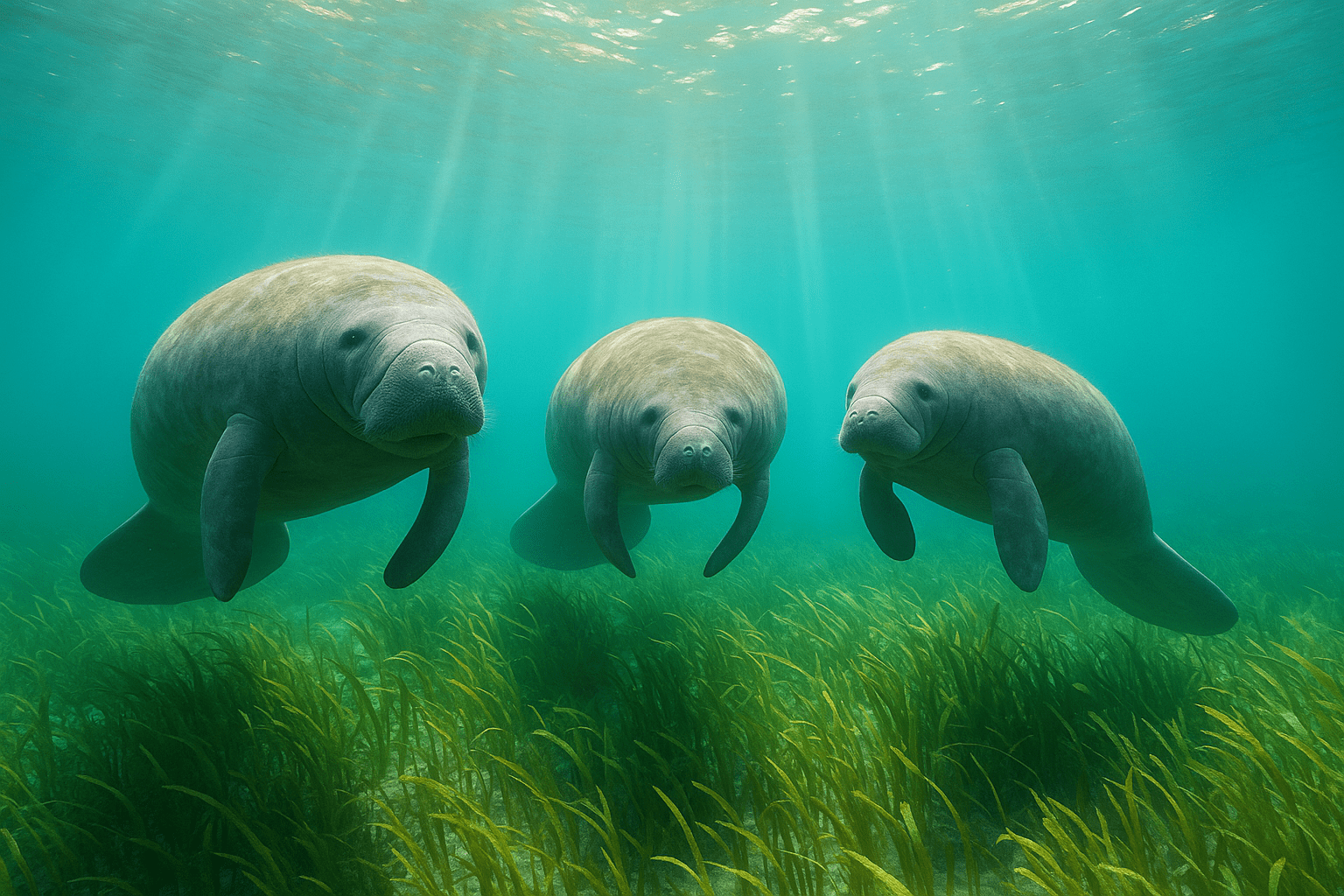
This passage explores these gentle sea cows, describing their physical features, feeding habits, habitats, and conservation challenges. Understanding how information is organised helps IELTS learners practise scanning, paraphrase recognition, and data interpretation effectively, essential for achieving Band 7 + in IELTS Reading.
Cambridge 20 Reading Test 2 Passage 1 – Manatees
Questions 1–6 | Notes Completion
This Notes Completion question type follows the passage order. To master strategies for recognising synonyms and avoiding traps, explore our detailed guide on Notes Completion in IELTS Reading.
- Look similar to dugongs, but with a differently shaped tail
Keywords: dugongs, shape, difference
Location: *Paragraph 1 — Lines 3–5 (“However, the manatee has a broad, rounded tail, whereas the dugong’s is fluked…”) *
Explanation: The passage contrasts the two animals’ tails directly. “Fluked” applies to dugongs; “broad, rounded” to manatees. This comparison confirms tail as the answer.
Answer: tail - Use their flippers to turn their bodies
Keywords: turn, look sideways
Location: Paragraph 2 — Lines 4–7 (“To see something on its left or its right, a manatee must turn its entire body, steering with its flippers.”)
Explanation: Manatees can’t rotate their heads sideways, so they steer using flippers. The synonym “steering” indicates the turning action required in the question.
Answer: flippers - Sense vibrations in water with hair
Keywords: sense, vibration, skin
Location: *Paragraph 2 — Lines 8–10 (“They also have some hairs covering their bodies which help them sense vibrations in the water…”) *
Explanation: The phrase clearly describes function and location. IELTS often paraphrases “sense” as “detect,” so learners must recognise synonym patterns.
Answer: hair - Feed mainly on seagrasses
Keywords: diet, aquatic plants
Location: Paragraph 3 — Lines 1–2 (“Seagrasses and other marine plants make up most of a manatee’s diet.”)
Explanation: The wording directly matches the question’s phrase “eat mainly aquatic vegetation.” This checks synonym comprehension between feed on and make up most of diet.
Answer: seagrasses - Grasp plants with their lips
Keywords: grasp, pull up, food
Location: *Paragraph 4 — Lines 5–7 (“Instead of having incisors… manatees have lips which function like a pair of hands to help tear food away…”) *
Explanation: The metaphor “function like a pair of hands” shows how lips work. The trap is thinking of “teeth,” but the sentence contrasts this explicitly.
Answer: lips - Regulate body buoyancy
Keywords: diaphragm, store air, float
Location: Paragraph 5 — Lines 6–9 (“They may use diaphragm contractions to compress and store gas in folds… to help them float.”)
Explanation: “Help them float” defines the function — controlling buoyancy. Recognising conceptual nouns like buoyancy is key in scientific texts.
Answer: buoyancy
If you want to learn how we scan and skim information quickly in IELTS Reading, explore our step-by-step guides on Scanning for Details and Summary Completion to build speed, accuracy, and confidence.
Questions 7–13 | True / False / Not Given
This True / False / Not Given question type follows the passage order, with each statement appearing sequentially. Focus on the meaning, not just matching words, IELTS often uses the same vocabulary to create opposite ideas. To learn how to recognise these traps and analyse factual statements effectively, explore our full guide on True / False / Not Given.
- West Indian manatees can be found in a variety of aquatic habitats.
Keywords: West Indian manatee, variety, different habitats
Location: Paragraph 6 — Lines 2–3 (“It moves between fresh water and salt water, taking advantage of coastal mangroves and coral reefs, rivers, lakes and lagoons.”)
Explanation: Multiple environments are listed — freshwater and saltwater — confirming variety.
Answer: TRUE - The Florida manatee lives in warmer waters than the Antillean manatee.
Keywords: Florida manatee, Antillean manatee, warmer waters
Location: Paragraph 6 — full paragraph
Explanation: Both ranges are described but temperatures aren’t compared.
Answer: NOT GIVEN - The African manatee’s range is limited to coastal waters between Mauritania and Angola.
Keywords: African manatee, limited to coast
Location: Paragraph 7 — Lines 2–3 (“The species also makes use of rivers… in landlocked countries such as Mali and Niger.”)
Explanation: Inland river habitats disprove the claim that it’s limited to coasts.
Answer: FALSE - The extent of the loss of Amazonian manatees was only revealed years later.
Keywords: Amazonian manatees, loss, revealed later
Location: *Paragraph 8 — Lines 2–4 (“It is estimated that 140,000 Amazonian manatees were killed between 1935 and 1954…”) *
Explanation: The passage mentions loss but not when it was discovered.
Answer: NOT GIVEN - It is predicted that West Indian manatee populations will fall in coming decades.
Keywords: predicted, decline, future
Location: Paragraph 9 — Lines 2–3 (“Both are expected to undergo a decline of 20% over the next 40 years.”)
Explanation: “Expected to undergo a decline” = predicted fall → TRUE.
Answer: TRUE - Risk from entanglement and plastic consumption increased from 2009–2020.
Keywords: entanglement, plastic consumption, increase
Location: Paragraph 9 — Lines 3–6 (“A review of almost 1,800 cases… at least 700 cases involved manatees.”)
Explanation: Statistics are given but no trend over time — no “increase” mentioned.
Answer: NOT GIVEN - There is legislation to reduce boat strikes on manatees in Florida.
Keywords: laws, Florida, boat speed
Location: Final paragraph — Lines 6–8 (“Laws in certain parts of Florida now limit boat speeds during winter…”)
Explanation: Limiting boat speed protects manatees → TRUE.
Answer: TRUE
Practice & Further Resources
Excellent work! You’ve completed the Cambridge 20 Reading Test 2 Passage 1 – Manatees passage. Keep your momentum going by exploring more question types in our 👉 IELTS Reading Practice Tests. For complete test preparation, practise the full Cambridge IELTS 20 series, including the Reading Test 2, Listening Test 2, Writing Test 2, and Speaking Test 2 to strengthen all four IELTS skills in an authentic exam format.
Tips for Success
- Read the title and first sentence of each paragraph to predict topic.
- Underline numbers, species names, and statistics, they often indicate answer locations.
- For TRUE/FALSE/NOT GIVEN, confirm whether the statement’s idea (not just words) matches the passage.
- Manage time wisely see our 👉 Time Management Tips.
Final Thoughts
The Cambridge 20 Reading Test 2 Passage 1 – Manatees passage combines scientific facts with environmental awareness, making it perfect for practising how to locate information and handle paraphrasing traps. Analysing each question type builds precision and confidence for higher bands.
Next, continue with Cambridge 20 Reading Test 2 Passage 2 – Procrastination, where a psychologist explains why we put off important tasks and how to overcome this common habit.
Important Vocabulary
To build your IELTS Reading vocabulary, explore our full IELTS Vocabulary page. Here are key words from Cambridge 20 Reading Test 2 Passage 1 – Manatees with simple meanings:
- Aquatic – living or growing in water. (Manatees are aquatic mammals.)
- Fluked – shaped like a whale’s tail with two rounded parts. (A dugong’s tail is fluked.)
- Propulsion – the force that moves something forward. (Manatees use their tail for propulsion.)
- Omnivorous – eating both plants and animals. (African manatees are omnivorous.)
- Buoyancy – the ability to float or stay up in water. (Manatees control their buoyancy using stored air.)
- Endangered – at serious risk of extinction. (All three manatee species are endangered.)
Learning these words will help you recognise paraphrases and understand descriptive scientific passages more confidently in the IELTS Reading test.
FAQ
Q1. Do Notes Completion questions follow order in IELTS Reading?
Yes, answers appear sequentially — each blank matches later sentences in the same order.
Q2. How can I identify traps in TRUE/FALSE/NOT GIVEN questions?
Watch for partial truths — words that match but change meaning subtly (e.g., some, only, always).
Q3. How many species of manatees are mentioned?
Three – West Indian, African, and Amazonian manatees.
Q4. What skills can this passage help improve?
Scanning for facts, recognising paraphrases, and understanding scientific vocabulary in context.
For authentic IELTS guidance and official updates, visit the British Council, IDP IELTS, and IELTS.org — the three organisations behind the IELTS exam. To complement your preparation with structured online study, explore expert-led programmes on Course Line – IELTS Preparation Courses.