I’m Hiroshi Tanaka, an IELTS Reading expert with nine years of experience teaching Cambridge passages, including Cambridge 20 Reading Test 3 Passage 1 – Frozen Food. At IELTS Zone, I help learners recognise paraphrases, track chronological information, and avoid factual traps — skills essential for achieving Band 7 and above.
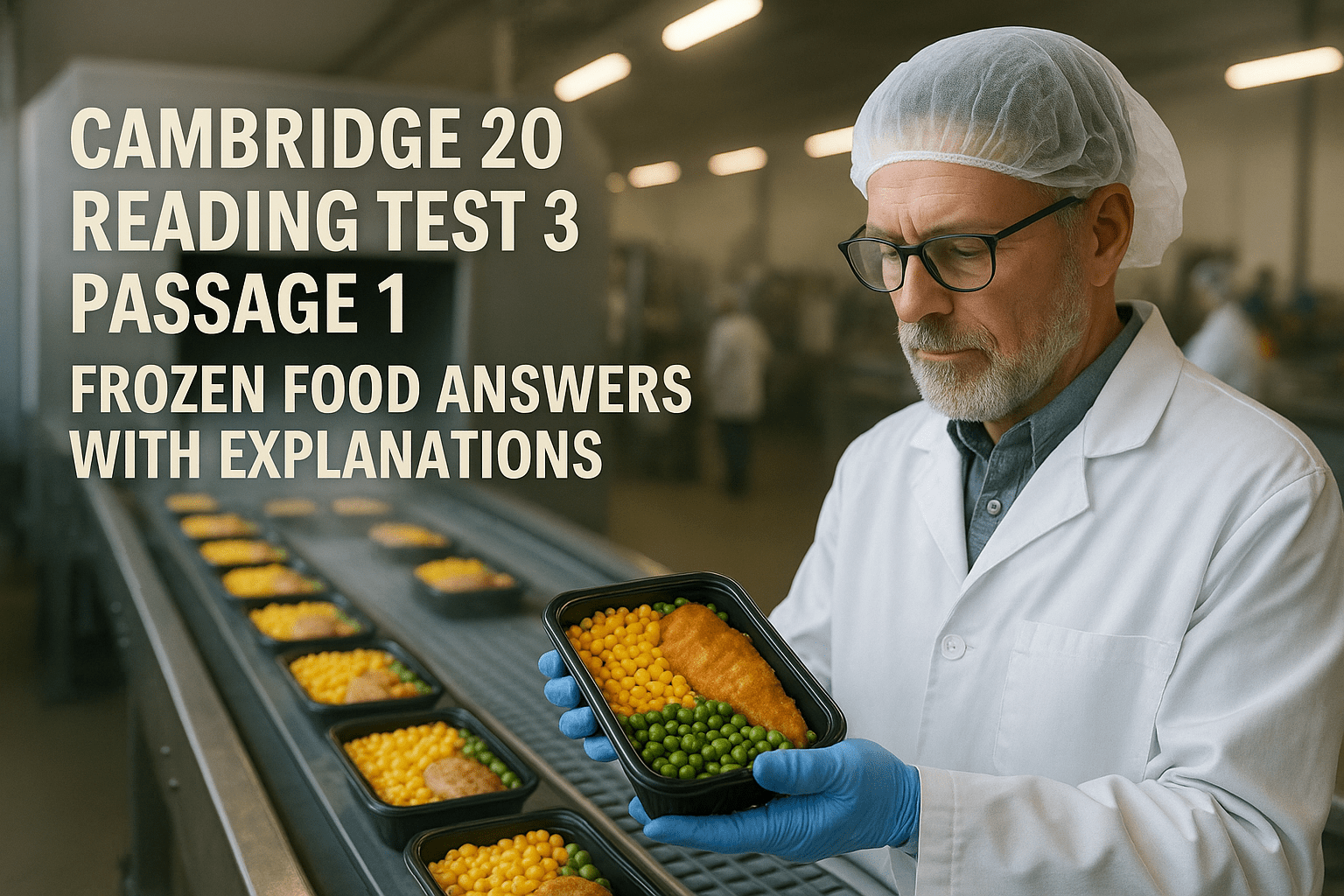
The Cambridge 20 Reading Test 3 Passage 1 – Frozen Food passage traces how the frozen-food industry developed, from ancient preservation methods to modern convenience meals. It explores early discoveries, key innovations by Clarence Birdseye, and the rise of consumer demand in mid-twentieth-century America. Understanding timelines, causes, and effects is vital for IELTS Reading success, especially in Notes Completion and True/False/Not Given tasks.
Cambridge 20 Reading Test 3 Passage 1 – Frozen Food Answers with Explanations
Questions 1–7 | Notes Completion
This Notes Completion question type follows passage order. To learn how to scan dates and keywords effectively, read our guide on Notes Completion in IELTS Reading.
- potatoes
Keywords: South America, conserved, freezing and drying
Location: Paragraph 1 — Lines 4–8 (“…conserving potatoes for later consumption… froze them overnight, then trampled them… then dried them in the sun.”)
Explanation: The ancient Andean people preserved potatoes by freezing and drying them.
Answer: potatoes - butter
Keywords: 1851, ice, rail cars
Location: Paragraph 2 — Lines 7–10 (“…to send butter from Ogdensburg, New York, to Boston.”)
Explanation: Butter was kept cool with ice during transportation in special railway carriages.
Answer: butter - meat
Keywords: 1880, Australia, first frozen food shipped
Location: Paragraph 4 — Lines 6–8 (“…a shipment of Australian beef and mutton was sent, frozen, to England.”)
Explanation: The first exported frozen foods were meat — beef and mutton.
Answer: meat - crystals
Keywords: quick-freezing, damage, spoil
Location: *Paragraph 6 — Lines 4–7 (“He developed quick-freezing techniques that reduced the damage that crystals caused…”) *
Explanation: Birdseye’s innovation minimised the damage caused by crystals, improving taste and texture.
Answer: crystals - cellophane
Keywords: packaging, see product
Location: *Paragraph 6 — Lines 7–9 (“…introduced the use of cellophane, the first transparent material for food packaging…”) *
Explanation: Birdseye used cellophane so consumers could view product quality.
Answer: cellophane - tin
Keywords: World War II, rationing, materials
Location: Paragraph 8 — Lines 1–4 (“…canned foods were rationed to save tin for the war effort, while frozen foods were abundant.”)
Explanation: A shortage of tin during WWII boosted frozen-food sales.
Answer: tin - refrigerator
Keywords: 1950s, homes, freezer compartments
Location: *Paragraph 8 — Lines 5–8 (“…by 1953, 33 million US families owned a refrigerator…”) *
Explanation: Affordable refrigerators encouraged the expansion of the frozen-food market.
Answer: refrigerator
If you want to learn how we scan and skim efficiently for keywords and numbers, explore our detailed guides on Scanning for Details and Summary Completion.
Questions 8–13 | True / False / Not Given
This True/False/Not Given question type follows passage order. Learn how to detect factual contrast and avoid traps in our guide on True / False / Not Given.
- The ice transportation business made some Boston ship owners very wealthy.
Location: Paragraph 2 — Lines 1–4
Explanation: The text mentions ship owners from Boston but not their wealth.
Answer: NOT GIVEN - A disadvantage of the freezing process invented in Australia was that it affected the taste of food.
Location: Paragraph 4 — Lines 8–12
Explanation: Expansion of ice crystals spoiled the food’s flavour and texture.
Answer: TRUE - Clarence Birdseye travelled to Labrador in order to learn how the Inuit people froze fish.
Location: Paragraph 5 — Lines 1–5
Explanation: He went there to trap and trade furs, not to study freezing; his observation was accidental.
Answer: FALSE - Swanson Foods invested a great deal of money in the promotion of the TV Dinner.
Location: *Paragraph 9 — Lines 4–7 (“…with the help of a clever name and a huge advertising budget…”) *
Explanation: A large advertising budget confirms heavy investment.
Answer: TRUE - Swanson Foods developed a new style of container for the launch of the TV Dinner.
Location: Paragraph 9 — Lines 5–7 (“…served in the same segmented aluminum tray that was used by airlines.”)
Explanation: The tray already existed; Swanson did not invent it.
Answer: FALSE - The US frozen food industry is currently the largest in the world.
Location: Final paragraph
Explanation: The passage states the industry’s value but no comparison with other countries.
Answer: NOT GIVEN
Practice & Further Resources
Excellent work! You’ve completed the Cambridge 20 Reading Test 3 Passage 1 – Frozen Food passage.
Keep practising with full tests in our 👉 IELTS Reading Practice Tests.
For complete preparation, study the Cambridge IELTS 20 series — Reading Test 3, Listening Test 3, Writing Test 3, and Speaking Test 3 — to build confidence across all skills.
Tips for Success
- Always note years and inventors’ names — common IELTS clues.
- Use scanning to find chronological information quickly.
- Don’t assume — if it’s not stated, choose Not Given.
- Practise similar historical passages in our 👉 Understanding Paraphrasing guide.
New Vocabulary
To build your IELTS Reading vocabulary, visit our full IELTS Vocabulary page.
Key words from Cambridge 20 Reading Test 3 – Frozen Food with simple meanings:
- Refrigeration – the process of keeping something cold to preserve it.
- Compressor – a machine that increases the pressure of a gas.
- Crystals – small ice formations that damage food texture when frozen slowly.
- Cellophane – a thin, transparent film used for food packaging.
- Convenience food – pre-prepared food that requires minimal effort to cook.
- Innovation – a new method or idea that improves existing processes.
Learning these terms improves comprehension of passages about science, history, and industry in IELTS Reading.
Final Thoughts
The Cambridge 20 Reading Test 3 Passage 1 – Frozen Food passage highlights human ingenuity — from ancient freezing to Birdseye’s industrial revolution — showing how necessity and innovation changed global eating habits. It strengthens your ability to follow timelines, recognise cause and effect, and interpret technological progress.
Next, continue with Cambridge 20 Reading Test 3 Passage 2 – Can the planet’s coral reefs be saved? where you’ll explore ancient civilisations and archaeological discoveries.
FAQ
Q1. Who was Clarence Birdseye?
An American inventor whose quick-freezing techniques founded the modern frozen-food industry.
Q2. Why did frozen food sales increase during World War II?
Because tin used for canned food was restricted, making frozen foods a cheaper option.
Q3. What made the TV Dinner so successful?
Convenience, a trusted brand, and strong advertising attracted millions of US families.
Q4. What IELTS skills does this passage improve?
Scanning for dates and facts, tracking innovation timelines, and recognising synonyms.
External References
For authentic IELTS guidance and official updates, visit the British Council, IDP IELTS, and IELTS.org — the three organisations behind the IELTS exam.
To build exam skills with expert-led courses, explore Course Line – IELTS Preparation Courses.