I’m Hiroshi Tanaka, an IELTS Reading expert with nine years of experience teaching Cambridge passages, including Cambridge 20 Reading Test 3 Passage 3 – Robots and Us. At IELTS Zone, I help learners identify viewpoints, interpret opinion-based questions, and understand inference logic — all crucial for achieving Band 7 and above in IELTS Reading.
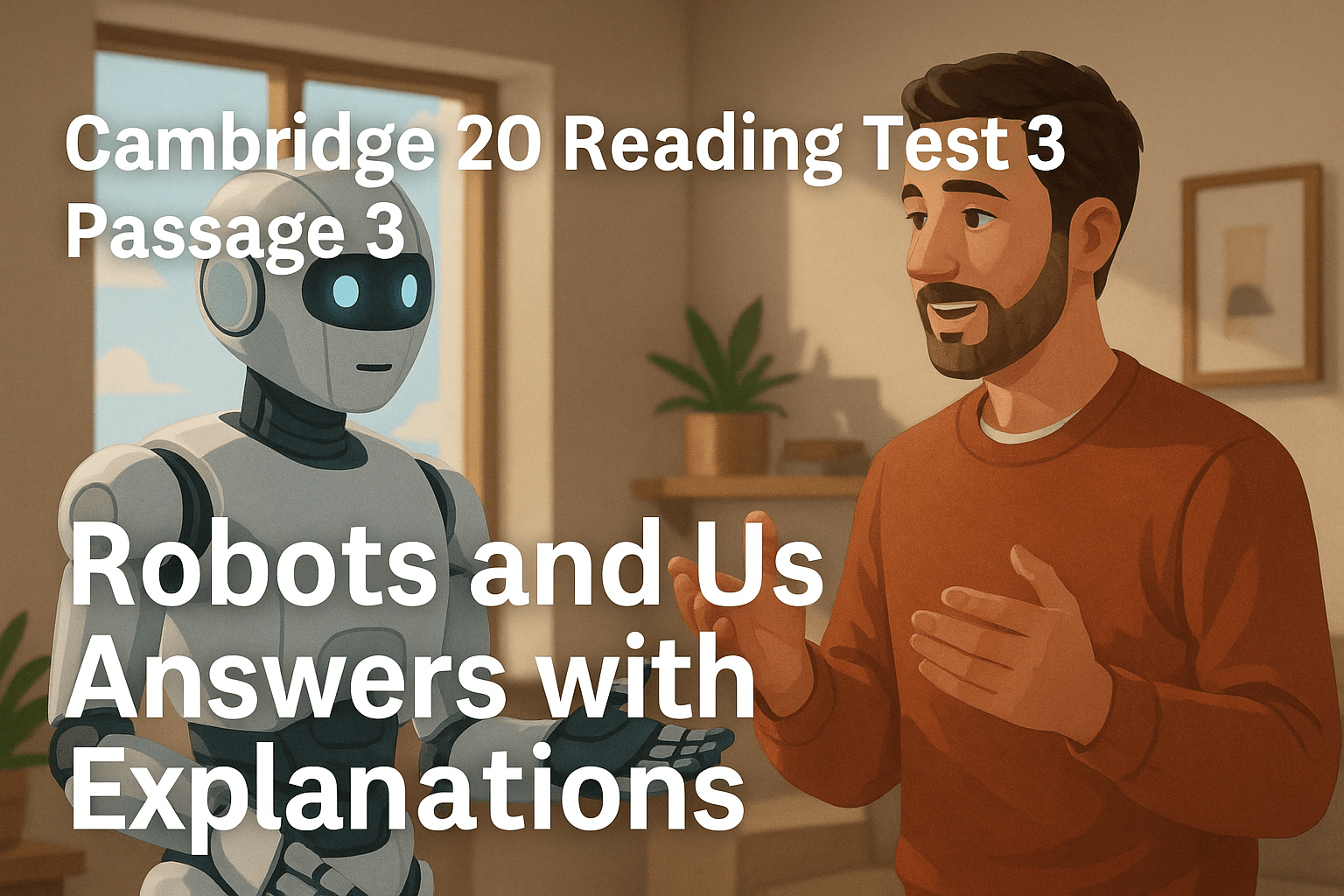
The Cambridge 20 Reading Test 3 Passage 3 – Robots and Us explores ethical and philosophical questions about how humans relate to artificial intelligence. Three experts — Martin Rees, Daniel Wolpert, and Kathleen Richardson — share their insights on robots in space, AI development, and our moral relationship with machines. This passage helps IELTS learners practise matching opinions, completing sentences, and multiple-choice reasoning, which are high-level comprehension skills.
Cambridge 20 Reading Test 3 Passage 3
Questions 27–33 | Matching Statements with Experts
This question type does not follow order. To master how to match expert views efficiently, visit our guide on Matching Features in IELTS Reading.
- For our own safety, humans will need to restrict the abilities of robots.
Answer: A – Martin Rees
Location: Paragraph 7 (‘…robots remain as no more than “idiot savants”…’)
Explanation: Rees warns that we must ensure robots never outwit humans — limiting their abilities for safety reasons. - The risk of robots harming us is less serious than humans believe it to be.
Answer: C – Kathleen Richardson
Location: Paragraph 8 (‘…none have in fact risen up and challenged human supremacy…’)
Explanation: Richardson believes the fear of robots is exaggerated; they have never posed a real threat. - It will take many decades for robot intelligence to be as imaginative as human intelligence.
Answer: B – Daniel Wolpert
Location: Paragraph 5 (‘…expecting a machine close to the creative intelligence of a human within 50 years would be highly ambitious.’)
Explanation: Wolpert doubts robots will achieve creative intelligence soon. - We may have to start considering whether we are treating robots fairly.
Answer: A – Martin Rees
Location: Paragraph 4 (‘…Should we feel guilty about exploiting [sophisticated robots]?…’)
Explanation: Rees questions whether humans should feel moral responsibility towards intelligent robots. - Robots are probably of more help to us on Earth than in space.
Answer: B – Daniel Wolpert
Location: Paragraph 2 (‘…using robots to gather resources nearer to home would seem to be a better use of our robotic tools.’)
Explanation: Wolpert prioritises Earth-based robotic uses over space exploration. - The ideas in high-quality science fiction may prove as accurate as those found in mediocre science.
Answer: A – Martin Rees
Location: Paragraph 10 (‘…it’s better to read first-rate science fiction than second-rate science…’)
Explanation: Rees believes good science fiction can be as insightful as weak scientific work. - There are those who look forward to robots developing greater intelligence.
Answer: C – Kathleen Richardson
Location: Paragraph 8 (‘…many people welcome machine intelligence.’)
Explanation: Richardson points out that some people are optimistic about intelligent robots.
If you want to learn how we scan and skim efficiently for keywords and numbers, explore our detailed guides on Scanning for Details and Summary Completion.
Questions 34–36 | Sentence Completion
- Richardson and Rees express similar views regarding the ethical aspect of …
Answer: C – changes made to other planets for our own benefit
Location: Paragraph 1 (Rees) + Paragraph 3 (Richardson)
Explanation: Both caution against colonising or altering planets for selfish reasons. - Rees and Wolpert share an opinion about the extent of …
Answer: B – advances made in machine intelligence so far
Location: Paragraph 4 (Rees) + Paragraph 5 (Wolpert)
Explanation: Both agree robots have advanced, but not yet matched human flexibility. - Wolpert disagrees with Richardson on the question of …
Answer: D – the harm already done by artificial intelligence
Location: Paragraph 7 (Wolpert) + Paragraph 8 (Richardson)
Explanation: Wolpert recognises AI damage (viruses), while Richardson argues AI has never harmed humans.
Questions 37–40 | Multiple Choice
- What point does Richardson make about fear of machines?
Answer: B – It is the result of our inclination to attribute human characteristics to non-human entities.
Location: Paragraph 6
Explanation: She believes fear comes from our tendency to personify machines. - What potential advance does Rees see as a cause for concern?
Answer: C – artificial intelligence developing independent thought.
Location: Paragraph 7 (‘…computer networks could behave like a single “brain”…’)
Explanation: Rees worries about computers developing independent goals. - What does Wolpert emphasise in his response to the question about science fiction?
Answer: B – how fundamental robots are to the science fiction genre.
Location: Paragraph 11 (‘…almost no science fiction envisages a future without robots.’)
Explanation: He highlights robots as central to most science-fiction worlds. - What is Richardson doing in her comment about reality and fantasy?
Answer: C – recommending a change of approach in how people view them.
Location: Final paragraph (‘…we need to bring these different understandings together…’)
Explanation: She encourages blending both perspectives for a fuller understanding of AI.
Practice & Further Resources
Excellent work! You’ve completed the Cambridge 20 Reading Test 3 Passage 3 – Robots and Us passage.
Keep improving your comprehension with our 👉 IELTS Reading Practice Tests.
For full coverage, complete the Cambridge IELTS 20 series — Reading Test 3, Listening Test 3, Writing Test 3, and Speaking Test 3.
Tips for Success
- Identify viewpoints: Underline names and note what each expert agrees or disagrees with.
- Avoid assumption traps: Opinions may contrast even when topics are similar.
- Pay attention to moral and hypothetical phrasing — e.g. should, could, might.
- Practise more on our 👉 Understanding Attitude and Opinion Questions.
New Vocabulary
To grow your IELTS Reading vocabulary, explore our full IELTS Vocabulary page. Key words from Cambridge 20 Reading Test 3 – Robots and Us:
- Terraforming – changing a planet’s environment to support human life.
- Autonomous – independent; capable of self-control or decision-making.
- Singularity – the moment AI becomes self-improving beyond human control.
- Ethics – moral principles guiding behaviour or choices.
- Futurologist – a person who predicts future technological or social developments.
- Malicious – intended to cause harm.
Understanding such terms strengthens comprehension of passages about science, technology, and society.
Final Thoughts
The Cambridge 20 Reading Test 3 Passage 3 – Robots and Us passage explores humanity’s evolving relationship with intelligent machines — balancing optimism, ethics, and caution. It helps you practise identifying expert opinions and comparing perspectives — an advanced IELTS Reading skill.
Next, continue with Cambridge 20 Reading Test 4 Passage 1 – Georgia O’Keeffe, where you’ll learn about the life and art of one of America’s most influential painters.
FAQ
Q1. What is the main topic of this passage?
Our moral and practical relationship with robots and artificial intelligence.
Q2. Which expert is most optimistic about robots?
Kathleen Richardson — she believes fears of AI are exaggerated.
Q3. Which expert worries about robot intelligence?
Martin Rees — he warns robots could become too powerful.
Q4. What IELTS skills does this passage improve?
Recognising viewpoints, comparing arguments, and matching expert opinions.
External References
For official IELTS information, visit the British Council, IDP IELTS, and IELTS.org.
To advance your preparation through structured lessons, explore Course Line – IELTS Preparation Courses.