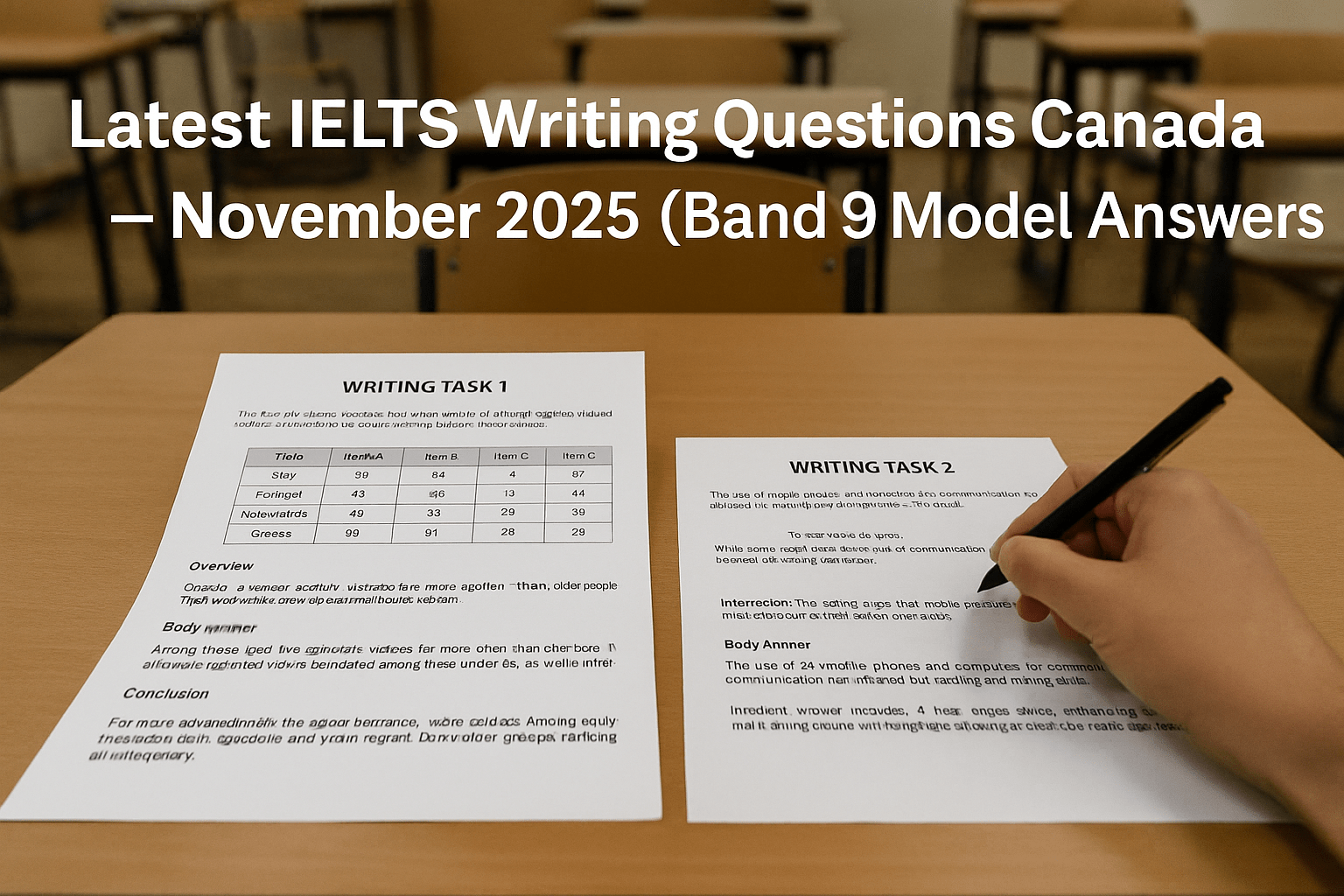
I’m Sarah Thompson, an IELTS Writing instructor with over 15 years of experience helping candidates achieve Band 8 and above. In this guide to Latest IELTS Writing Questions Canada, you’ll find Band 9 model answers and strategies designed specifically for the Academic Writing (AC) module, based on real exam topics.
For a full global overview of this year’s Academic Writing tasks, visit our master post: Latest IELTS Writing Questions 2025 (Band 9 Model Answers – AC)
Welcome to the Latest IELTS Writing Questions Canada – November 2025 (Academic Module) guide. This post brings you authentic IELTS Academic Writing questions recently reported by test takers in Canada, complete with Band 9 model answers, examiner-style analysis, and essential vocabulary to help you reach your target score.
The Academic Writing test includes two key components:
- Task 1 – a data-based report, often involving a table, chart, or graph.
- Task 2 – a formal essay requiring clear argumentation and logical structure.
In this edition, you’ll explore a Task 1 table question alongside a Task 2 discussion essay, each demonstrating strong coherence, lexical range, and grammatical accuracy.
To improve your preparation, you can review our expert guides on Task 1 Format & Assessment, Describing Trends & Comparisons, IELTS Essay Types (Task 2), and Formal Tone & Style. These resources provide practical frameworks and sample structures to help you refine your writing for the next test date.
Task 1 (Academic Report)
This section presents the Task 1 Academic Writing question from the November 2025 IELTS exam in Canada. The data compares how often Australians from various age groups watched videos online, highlighting generational differences in viewing habits.
For further learning, see Task 1 Format & Assessment, Describing Trends & Comparisons, and Data Vocabulary for Academic Task 1.
Question:
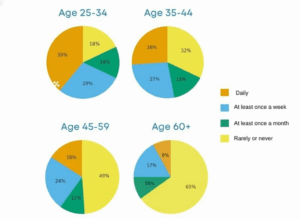
The charts below show how often people of different age groups in Australia watched videos online. Summarise the information by selecting and reporting the main features, and make comparisons where relevant.
Band 9 Model Answer (159 words)
The four pie charts illustrate how frequently people in Australia watched videos online, divided into four age groups ranging from 25 to over 60 years old.
Overall, younger adults watched videos far more often than older people. Daily and weekly viewing was most common among those under 45, while infrequent viewing dominated among the older groups.
Among those aged 25–34, nearly 40% watched videos daily, and about 29% did so weekly. A similar trend appeared in the 35–44 group, where 36% viewed content daily and 27% weekly. Monthly viewing remained comparatively low for both younger groups, at around 14–15%.
For the 45–59 group, viewing dropped sharply, with almost half (49%) rarely or never watching and only 16% doing so daily. Among those aged 60+, infrequent viewing was dominant at 65%, and just 8% watched daily, showing a clear age-related decline in online engagement.
For more advanced writing practice, explore our expert resources on Task 1 Format & Assessment, Describing Trends & Comparisons, and Data Vocabulary for Academic Task 1. These guides provide structured examples and techniques to help you strengthen coherence, comparisons, and vocabulary accuracy in IELTS Academic Task 1.
Task 2 (Academic Essay)
This section presents the Task 2 Academic essay from the November 2025 IELTS test in Canada. The topic explores whether digital communication through mobile phones and computers has influenced people’s reading and writing skills, a highly relevant issue in today’s technology-driven world.
For structured essay preparation, review our guides on IELTS Essay Types (Task 2), Essay Structure for Band 7+, and Formal Tone & Style.
Question:
The use of mobile phones and computers for communication has affected our reading and writing skills.
To what extent do you agree or disagree?
Band 9 Model Essay (268 words)
The growing use of mobile phones and computers has transformed the way people communicate. While some argue that these technologies have weakened our reading and writing abilities, I believe they have simply changed how these skills are developed and practised in modern contexts.
It is true that digital communication often encourages brief and informal exchanges, which may reduce exposure to traditional reading and writing forms. Many people rely on emojis, abbreviations, and voice messages rather than complete sentences. As a result, spelling accuracy and grammatical precision can decline, particularly among younger users who spend more time texting than reading books or formal content. This shift can make traditional literacy appear less relevant in daily communication.
However, digital devices have also expanded opportunities for reading and writing. Online articles, blogs, and discussion platforms require users to process and create large volumes of written text. Students and professionals frequently compose emails, reports, and posts, which still demand clear structure and vocabulary. Moreover, access to digital tools such as grammar checkers and e-readers can enhance accuracy and fluency, encouraging active engagement with language.
Although modern technology has altered the format of reading and writing, it has not necessarily harmed these skills. Instead, it has diversified how people practise them, blending efficiency with accessibility in the digital age.
For more advanced writing practice, explore our expert resources on IELTS Essay Types (Task 2), Essay Structure for Band 7+, and Developing Academic Vocabulary for IELTS Writing. These guides provide frameworks and sample answers to strengthen your coherence, argumentation, and lexical range.
Band 9 Analysis
Task 1 – Table Report
Task Achievement: The answer identifies and compares the most relevant data while avoiding unnecessary detail.
Coherence & Cohesion: Logical progression with clear connectors such as in contrast and among those aged ….
Lexical Resource: Mature, topic-specific vocabulary appears naturally (viewing frequency, decline with age, engagement).
Grammar Range & Accuracy: Accurate use of complex and compound structures.
Teaching note: The overview succinctly summarises the main trend without repeating numbers – a key Band 9 feature.
Task 2 – Essay
Task Response: Direct, balanced opinion fully addresses the question.
Coherence & Cohesion: Ideas flow smoothly, linked by cohesive devices (however, as a result, moreover).
Lexical Resource: Excellent range of academic and technology-related terms (fluency, diversified, accuracy).
Grammar Range & Accuracy: Consistent control of tenses, conditionals, and complex clauses.
Teaching note: A balanced argument demonstrates critical thinking and precise stance expression.
Tips for Success
- Plan before writing: Spend 2–3 minutes outlining your main points or data.
- Write an overview early: Present key trends clearly without listing all figures.
- Stay formal: Avoid contractions and everyday expressions.
- Use logical connectors: Words like however and while ensure flow.
- Proofread carefully: Check verb forms, articles, and plurals before submission.
Vocabulary Highlights
Use the following advanced terms naturally in your writing:
- Engagement – active involvement or participation. Example: Online engagement among younger adults is consistently high.
- Decline – a decrease or reduction. Example: Viewing frequency declines steadily with age.
- Proportion – a share or percentage. Example: A large proportion of users watch videos daily.
- Dominant – most common or influential. Example: Infrequent viewing is dominant among older groups.
- Efficiency – the ability to achieve results with minimal effort. Example: Digital tools improve writing efficiency.
- Precision – accuracy or exactness. Example: Texting can reduce grammatical precision.
- Exposure – experience of something. Example: Less exposure to books may weaken vocabulary.
- Accessibility – ease of use or reach. Example: E-books have increased accessibility to reading materials.
- Structure – organised arrangement. Example: The essay shows a clear structure.
- Fluency – smooth flow of language. Example: Frequent reading enhances fluency.
- Diversified – made more varied. Example: Communication has become diversified through technology.
- Platform – medium for communication. Example: Social platforms encourage writing practice.
- Accuracy – correctness in detail. Example: Grammar tools improve accuracy.
- Trend – general direction of change. Example: The charts reveal a downward trend among older adults.
- Context – situation or background. Example: Digital reading occurs in an informal context.
Useful Collocations
Incorporate these expressions naturally to sound more academic:
- Highlight a trend – The report highlights a clear age-related trend.
- Draw a comparison – The writer draws a comparison between age groups.
- Support an argument – Strong evidence supports an argument effectively.
- Express a viewpoint – Candidates must express a clear viewpoint in Task 2.
- Maintain coherence – Logical paragraphing maintains coherence throughout.
- Demonstrate understanding – Complex sentences demonstrate grammatical understanding.
- Enhance vocabulary – Reading journals helps enhance vocabulary range.
- Show contrast – Linkers like however show contrast between ideas.
FAQ
Q1. Can I include exact percentages in Task 1?
Yes, but focus on key features rather than every number.
Q2. How long should Task 2 be?
Around 260–280 words – concise yet fully developed.
Q3. May I use first-person pronouns in Task 2?
Yes, sparingly. Use I believe or I agree while remaining formal.
Q4. What if I finish early?
Proofread carefully for grammar and coherence.
Q5. How many paragraphs should Task 2 have?
Four: an introduction, two body paragraphs, and a conclusion.
Further Practice & Resources
Continue improving with our detailed guides:
IELTS Writing Task 1: Describing Data and Comparisons, IELTS Writing Task 2: Opinion and Discussion Essays, Using Complex Sentences in IELTS Writing, IELTS Grammar for Band 8 and Above, IELTS Vocabulary for Technology and Education, and Writing Coherence and Cohesion Guide.
These resources provide frameworks, examples, and advanced vocabulary for both tasks.
References
For official IELTS test details and assessment criteria, visit IELTS.org, the British Council, and IDP IELTS websites. Learners seeking structured preparation can also explore Course Line IELTS for guided study and examiner-reviewed practice.
Disclaimer
This material is produced purely for educational purposes. It is not affiliated with Cambridge Assessment English, IDP IELTS, or the British Council. All sample questions and model answers are independently written to help candidates understand high-band performance features.