I’m Sarah Thompson, an IELTS Writing instructor with over 15 years of experience helping students achieve Band 8 and above. In this guide to the Latest IELTS Writing Questions Saudi Arabia, you’ll find authentic Band 9 model answers and professional insights for mastering the Academic Writing (AC) module in the October 2025 test.
For a full global overview of this year’s Academic Writing tasks, visit our master post: Latest IELTS Writing Questions 2025 (Band 9 Model Answers – AC)
Welcome to the New IELTS Questions from Saudi Arabia – October 2025 (Academic Module) guide. This post features genuine IELTS Academic Writing tasks reported by candidates across Saudi Arabia, with full Band 9 model answers, detailed explanations, and examiner-style insights to help you perform confidently in the test.
The IELTS Academic Writing Test contains two key parts:
- Task 1 – a report based on visual data such as charts, tables, or graphs.
- Task 2 – a formal essay that evaluates your ability to develop arguments logically and coherently.
In this edition, we examine a Task 1 line graph comparing mobile and fixed-line phone users in Africa, and a Task 2 essay discussing the impact of fast food on health, families, and society. Each model is written to demonstrate the precision and structure expected at Band 9 level.
For more guidance, explore our key writing resources including Task 1 Format & Assessment, Describing Trends & Comparisons, IELTS Essay Types (Task 2), and Formal Tone & Style. These expert guides will help you strengthen your organisation, coherence, and lexical range across both tasks.
Let’s begin with the Task 1 Academic Writing report from the October 2025 IELTS exam in Saudi Arabia.
Task 1 (Academic Report)
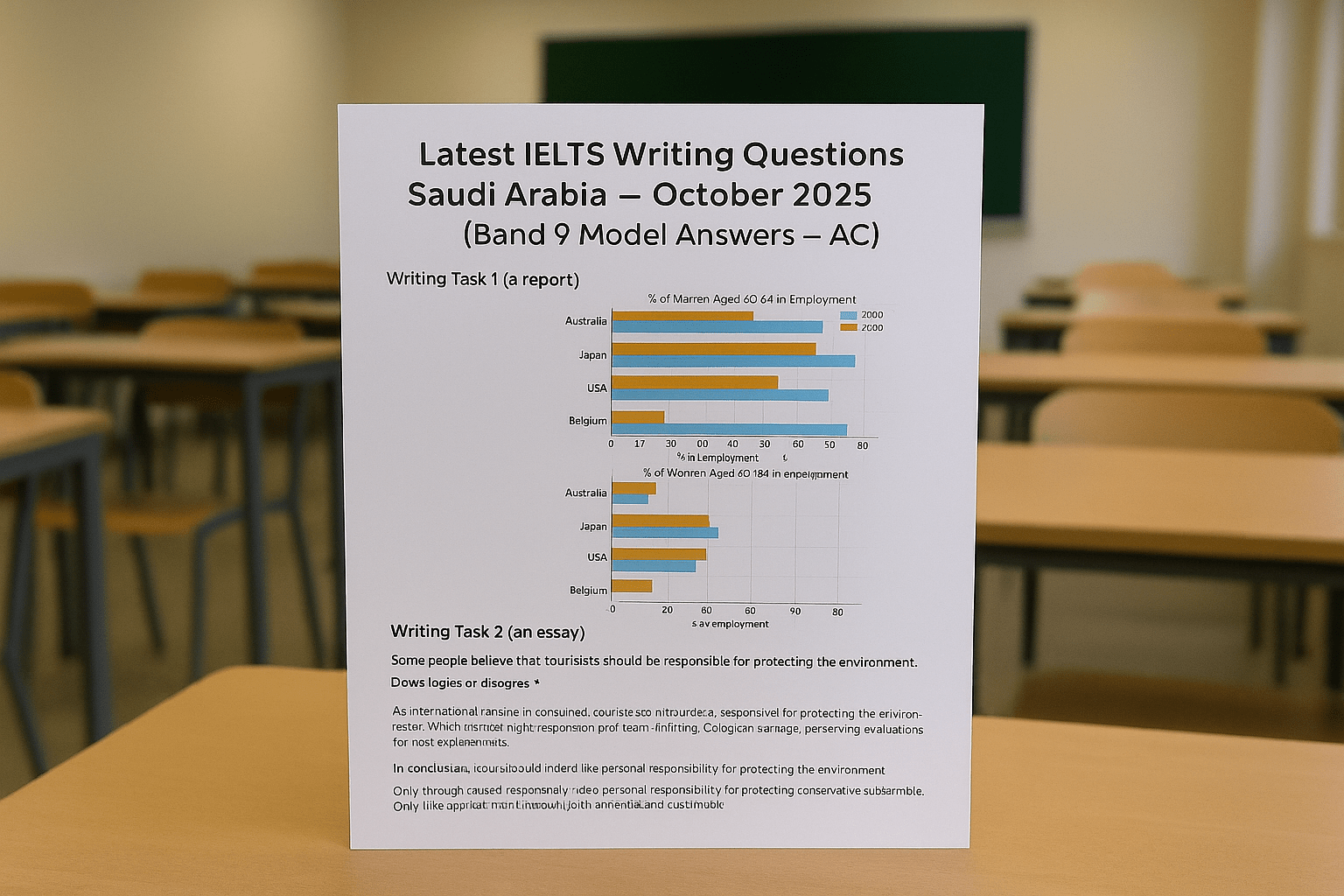
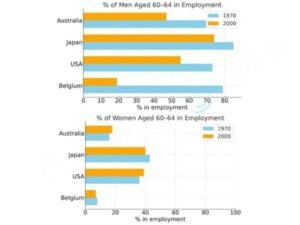
This section presents the Task 1 Academic Writing question from the October 2025 IELTS exam in Saudi Arabia. The bar charts compare the percentage of men and women aged 60–64 in employment across four countries — Australia, Japan, the USA, and Belgium — in 1970 and 2000.
For step-by-step guidance, see Task 1 Format & Assessment, Describing Trends & Comparisons, and Data Vocabulary for Academic Task 1.
Question:
The charts below show the percentage of men and women aged 60–64 in employment in four countries, in 1970 and 2000. Summarise the information by selecting and reporting the main features, and make comparisons where relevant.
Band 9 Model Answer (158 words)
The two bar charts compare the proportion of men and women aged 60–64 who were employed in four countries in 1970 and 2000.
Overall, employment rates for both genders declined in all four countries during the period, though the decrease was generally more significant for men than for women. The USA consistently recorded the highest employment levels, while Belgium had the lowest.
In 1970, around 75% of American men in this age group were employed, compared with approximately 70% in Japan and 65% in Belgium. By 2000, these figures had dropped notably, to about 55%, 60%, and 40% respectively. Australia also experienced a decline, with male employment falling from around 70% to 50%.
A similar downward trend was seen among women. In 1970, employment among women aged 60–64 ranged between 10% and 40%, but by 2000, levels were lower in every country. Japan and the USA maintained relatively higher female participation than Belgium and Australia.
For more advanced Task 1 preparation, explore Task 1 Format & Assessment, Describing Trends & Comparisons, and Data Vocabulary for Academic Task 1. These resources demonstrate how to structure clear overviews and highlight comparative data effectively.
Task 2 (Academic Essay)
This section presents the Task 2 Academic Writing essay from the October 2025 IELTS exam in Saudi Arabia. The topic examines whether tourists themselves should be responsible for protecting the environment, a question that highlights global sustainability concerns in modern travel.
For essay structure and planning tips, review IELTS Essay Types (Task 2), Essay Structure for Band 7+, and Formal Tone & Style.
Question:
Some people believe that tourists should be responsible for protecting the environment.
Do you agree or disagree?
Band 9 Model Essay (268 words)
As international tourism continues to expand, its environmental impact has become a growing concern. While some argue that protecting the environment is primarily the duty of local authorities, I believe tourists also share responsibility for minimising ecological damage and preserving destinations for future generations.
Tourists directly contribute to environmental issues such as littering, pollution, and resource depletion; therefore, they should play an active role in preventing harm. Responsible actions — such as avoiding single-use plastics, respecting wildlife, and reducing water waste — can significantly lessen the environmental footprint of travel. For example, many eco-conscious visitors to Saudi Arabia’s natural reserves now follow government guidelines on sustainable tourism, helping to preserve local ecosystems and heritage sites.
However, individual effort alone is insufficient without proper infrastructure and regulation. Governments and tourism operators must provide clear information, waste management facilities, and eco-friendly options to encourage compliance. Tourists can only act responsibly when sustainable systems are in place. For instance, initiatives like green transport, recycling stations, and eco-certification for hotels make it easier for travellers to adopt environmentally conscious habits. Thus, both tourists and authorities must collaborate to protect natural environments effectively.
In conclusion, tourists should indeed take personal responsibility for protecting the environment, but lasting change requires joint action with local governments and businesses. Only through shared responsibility can tourism remain both enjoyable and sustainable.
To strengthen your essay writing, explore IELTS Essay Types (Task 2), Essay Structure for Band 7+, and Developing Academic Vocabulary for IELTS Writing. These guides provide frameworks, model essays, and practical tips to help you express opinions with clarity and confidence.
Band 9 Analysis
Task 1 – Bar Charts (Employment of Older Adults)
Task Achievement:
All key data are accurately selected and compared. The overview highlights the major pattern — a general decline in employment among both men and women aged 60–64 — without unnecessary detail.
Coherence & Cohesion:
Logical flow with clear paragraphing and linking expressions such as in contrast, overall, and by comparison. Information is grouped sensibly by gender and year.
Lexical Resource:
Advanced yet natural vocabulary, e.g. proportion, employment rate, decline, participation level, and labour force.
Grammar Range & Accuracy:
Excellent use of complex structures (comparatives, adverbial clauses) with full grammatical accuracy.
Teaching note: The overview is concise and analytical — an essential feature of Band 9 writing.
Task 2 – Essay (Tourists & Environmental Responsibility)
Task Response:
Fully addresses the prompt with a clear, balanced stance. Each paragraph develops a distinct argument with relevant examples.
Coherence & Cohesion:
Paragraphs are well-structured, supported by cohesive devices (for example, thus, in conclusion). Logical order enhances readability.
Lexical Resource:
Strong academic word choice (sustainability, ecological footprint, collaboration, preserve ecosystems).
Grammar Range & Accuracy:
Accurate complex sentences and precise verb forms throughout.
Teaching note: The essay maintains a consistent position while acknowledging multiple perspectives — a key Band 9 strategy.
Tips for Success
- Write a clear overview: Summarise the main pattern before presenting numbers.
- Group logically: Compare countries or genders rather than listing data.
- Plan Task 2 before writing: Outline your stance and supporting ideas.
- Use topic-specific vocabulary: Terms like sustainability or employment rate show range.
- Proofread for cohesion: Replace repetitive linkers with varied connectors such as whereas, while, and therefore.
Vocabulary Highlights
Here are 15 advanced words and expressions drawn from both tasks — use them naturally in your writing:
- Proportion – a share or amount compared with the total. Example: The proportion of employed men declined steadily.
- Decline – a decrease or reduction. Example: There was a sharp decline in employment after 1970.
- Participation rate – level of involvement in a specific activity. Example: Japan maintained a higher participation rate among women.
- Labour force – total number of people available for work. Example: The ageing labour force affects national productivity.
- Sustainability – ability to continue without harming the environment. Example: Sustainable tourism protects natural habitats.
- Ecological footprint – the environmental impact of human activity. Example: Tourists can reduce their ecological footprint by using public transport.
- Collaboration – working together towards a common goal. Example: Environmental protection requires collaboration between travellers and authorities.
- Infrastructure – basic facilities such as roads and waste systems. Example: Green infrastructure supports eco-friendly tourism.
- Regulation – official rule or policy. Example: Stronger environmental regulations improve visitor behaviour.
- Preserve – to maintain or protect something valuable. Example: Tourists should help preserve cultural heritage sites.
- Awareness – understanding or knowledge about an issue. Example: Campaigns raise awareness of sustainable travel.
- Responsibility – duty or obligation. Example: Tourists have a responsibility to minimise damage to ecosystems.
- Initiative – new plan or project. Example: Eco-tourism initiatives reduce waste and pollution.
- Habitat – natural living environment of a species. Example: Littering can destroy fragile coastal habitats.
- Conservation – protection of natural resources. Example: Conservation efforts rely on responsible tourism practices.
Useful Collocations
Incorporate these high-value expressions naturally in IELTS Writing:
- Highlight a trend – The report highlights a steady decline in employment.
- Draw a comparison – The writer draws a comparison between male and female workers.
- Show a contrast – The charts show a contrast between countries.
- Promote sustainability – Travel companies should promote sustainability in tourism.
- Take responsibility – Tourists must take responsibility for environmental protection.
- Preserve the environment – Eco-friendly initiatives help preserve the environment.
- Raise awareness – Media campaigns raise awareness about pollution.
- Implement regulations – Governments should implement regulations for eco-tourism.
FAQ
Q1. Can I describe every number in Task 1?
No. Focus on the most significant comparisons and overall trends only.
Q2. How long should my Task 2 essay be?
Aim for 260–280 words — enough to fully develop ideas without repetition.
Q3. Should I use personal pronouns in Task 2?
Yes, moderately. Using I agree or I believe is fine if the tone remains formal.
Q4. How do I avoid repetition?
Use synonyms (rise → increase → growth) and paraphrase structures.
Q5. What makes a Band 9 overview?
It summarises key trends and comparisons clearly, without data overload or interpretation errors.
Further Practice & Resources
For more structured writing improvement, explore:
IELTS Writing Task 1: Describing Data and Comparisons,
IELTS Writing Task 2: Opinion and Discussion Essays,
Using Complex Sentences in IELTS Writing,
IELTS Grammar for Band 8 and Above,
IELTS Vocabulary for Environment and Work Topics, and
Writing Coherence and Cohesion Guide.
These guides provide tested frameworks, sample answers, and examiner-approved strategies for Academic Writing.
References & Disclaimer
For official information on IELTS exam formats, marking criteria, and preparation resources, visit IELTS.org, the British Council, and IDP IELTS. Learners may also explore Course Line IELTS for guided study and examiner-reviewed feedback.
This content is created for educational purposes only and is not affiliated with Cambridge Assessment English, IDP IELTS, or the British Council. All sample tasks and answers are independently written to demonstrate Band 9-level writing features.