
I’m Sarah Thompson, an IELTS Writing expert with over 15 years of teaching experience, helping learners achieve Band 8 and above. In this ultimate guide to the Latest IELTS Writing Questions 2025, you’ll find updated tasks, Band 9 model answers, and advanced strategies for the Academic Writing (AC) module.
Welcome to the Latest IELTS Writing Questions 2025 (Academic Module) – your complete reference for all the most recent IELTS Writing tasks reported by students around the world.
Whether you’re preparing for an exam in Canada, Saudi Arabia, the UK, Australia, or elsewhere, this post brings together every Task 1 and Task 2 question, complete with Band 9 model answers, examiner-style feedback, and advanced writing tips to help you maximise your score.
You’ll also find internal links to our regional IELTS updates for each month and country, so you can study authentic, location-specific writing topics directly from recent test sessions.
For structured practice, see Task 1 Format & Assessment, Describing Trends & Comparisons, IELTS Essay Types (Task 2), and Formal Tone & Style.
IELTS Writing Question Updates by Country (2025)
🇨🇦 Canada – November 2025
🇸🇦 Saudi Arabia – October 2025
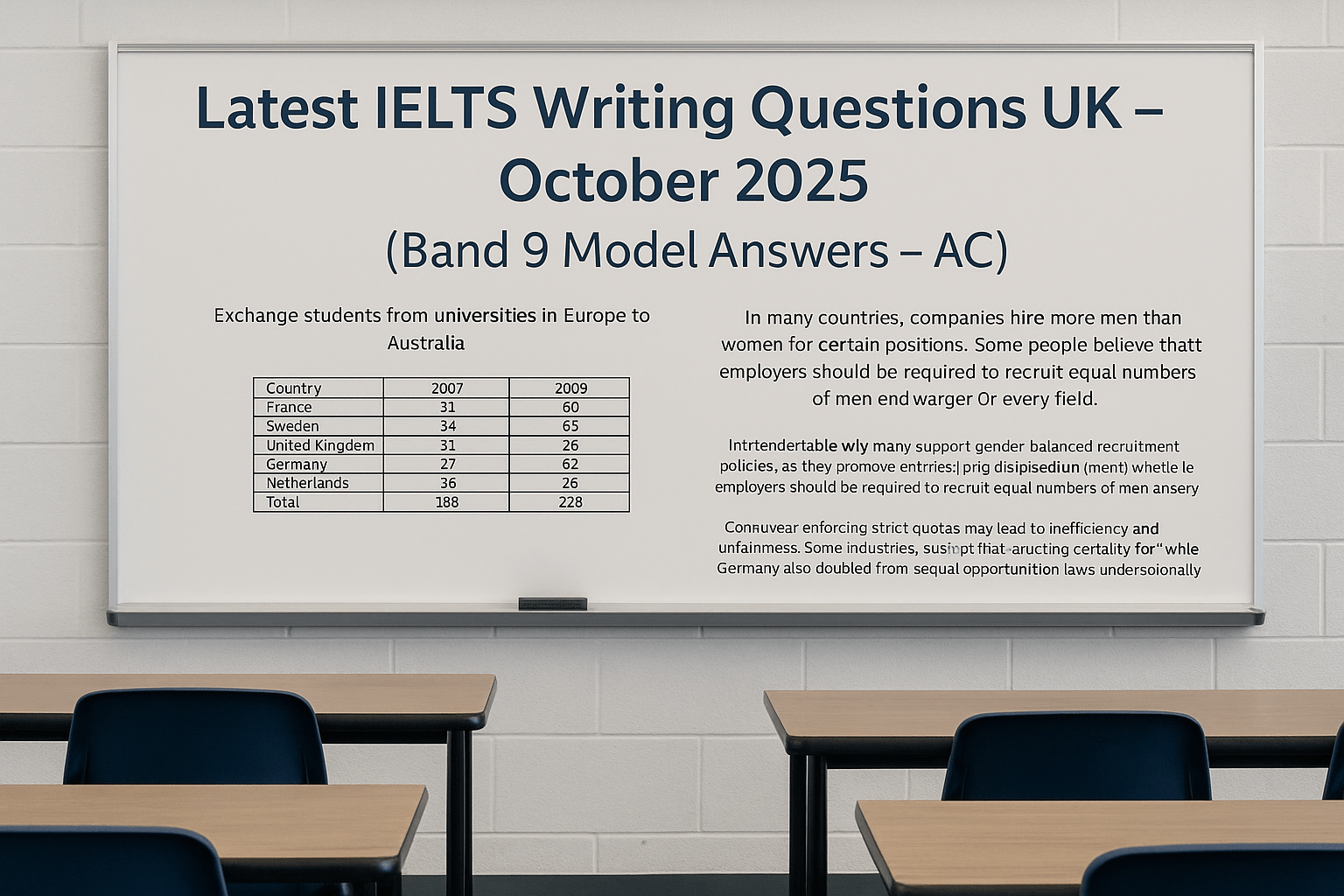
🇬🇧 United Kingdom – October 2025
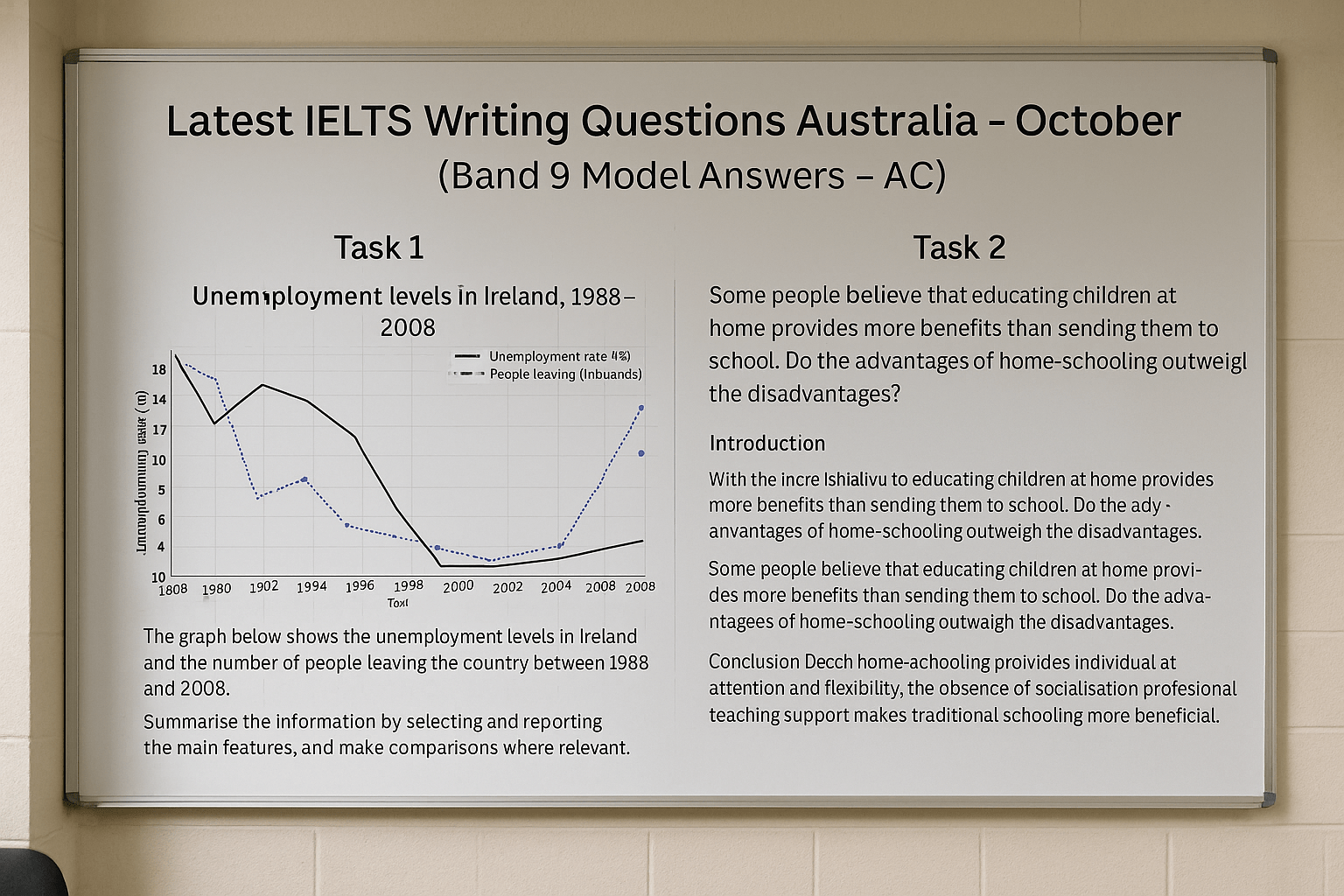
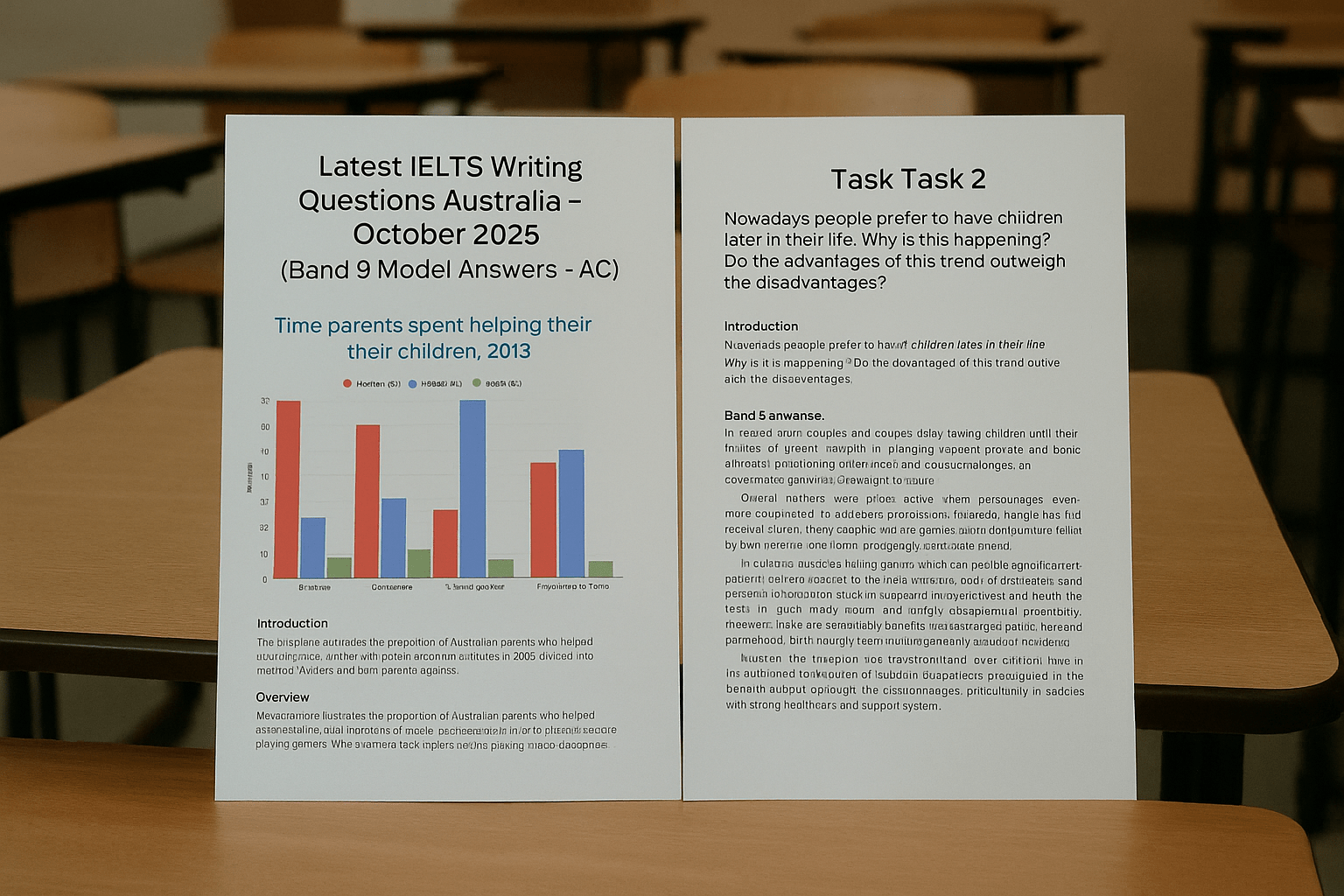
🇦🇺 Australia – October 2025
Writing Trends Observed
- Task 1:
- Most visuals feature comparative data (line graphs, bar charts, tables).
- Focus on changes over time and cross-category analysis.
- Increasing appearance of environmental and digital communication topics.
- Task 2:
- Common themes: technology and society, health and food culture, gender and work, education and parenting.
- Opinion essays remain the most frequent type, followed by discussion and advantage/disadvantage essays.
Examiner Notes
- High Band scores depend on coherence, clear overview, and lexical variety.
- Candidates often lose marks for lack of overview in Task 1 or unclear stance in Task 2.
- Balanced arguments and advanced topic-specific vocabulary are key to achieving Band 8–9.
Expert Tips
- Always write an overview in Task 1 – never skip it.
- Use precise data comparisons instead of repeating figures.
- Plan your essay for 3–5 minutes before writing.
- Balance your arguments with examples and linking phrases.
- Check grammar for article use, plurals, and tense consistency.
Vocabulary Highlights
- Technology: digital communication, automation, accessibility, innovation.
- Education: assessment criteria, academic discipline, lifelong learning.
- Environment: sustainable development, ecological impact, carbon footprint.
- Society: gender parity, social mobility, cultural preservation.
- Health: dietary habits, mental wellbeing, sedentary lifestyle.
Useful Collocations
- Present data clearly
- Highlight a trend
- Support an argument
- Express a viewpoint
- Maintain coherence
- Promote equality
- Preserve traditions
- Draw a conclusion
FAQ
Q1. How often is this blog updated?
Monthly — whenever new IELTS Writing questions are reported globally.
Q2. Does this include General Training?
No. This blog focuses exclusively on IELTS Academic Writing (AC).
Q3. Are these official IELTS tasks?
They’re genuine questions reported by recent test-takers and used for educational guidance.
Q4. What score can these models achieve?
Each model is written to meet Band 9 criteria across all four marking areas.
Q5. Where can I find more IELTS practice?
Check out our dedicated guides for IELTS Writing Task 1 and IELTS Writing Task 2 for detailed structures and sample answers.
Further Resources
Explore more advanced IELTS Writing tools and guides:
IELTS Writing Task 1: Charts and Tables,
IELTS Writing Task 2: Opinion Essays,
IELTS Grammar for Band 8 and Above,
IELTS Vocabulary by Topic, and
IELTS Writing Mistakes to Avoid.
References & Disclaimer
For official IELTS exam information and updates, visit IELTS.org, the British Council, and IDP IELTS.
This article is for educational use only and is not affiliated with Cambridge Assessment English, IDP, or the British Council.