Written by Jonathan Mitchell – IELTS examiner and instructor based in London with over 15 years of experience helping students across Europe achieve Band 7–9 in IELTS Speaking.
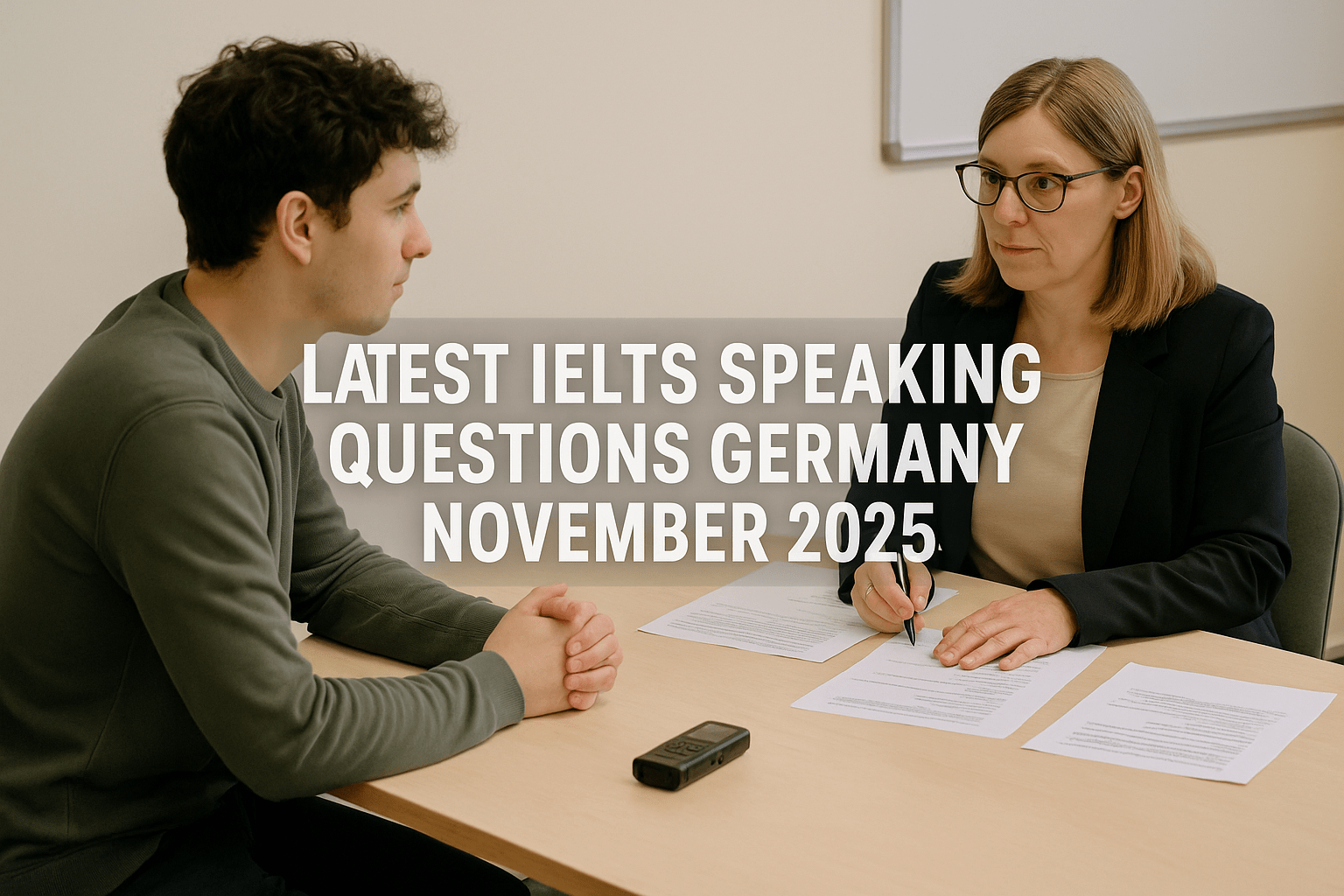
Welcome to the Latest IELTS Speaking Questions Germany blog for November 2025. These questions were kindly shared by M.T., who recently took the IELTS Academic test in Germany. Below, you’ll find Band 9 sample answers with examiner feedback to help you understand tone, structure, and topic vocabulary. For complete test details, see our IELTS Speaking Complete Guide.
Part 1 – Introduction & Interview
In Part 1, the examiner asks short questions on familiar topics to assess fluency and natural communication. Read our IELTS Speaking Part 1 Tips for strategies.
What do you like most about your hometown?
I love the peaceful atmosphere and the small parks scattered around the city. It’s a great place to unwind after a long day, especially during spring when everything blooms.
Examiner Feedback: Natural rhythm and descriptive vocabulary (“peaceful atmosphere,” “blooms”) → Band 9.
How long have you been living there?
I’ve lived there since childhood, so it feels like part of who I am. Even after travelling abroad, I always look forward to coming back home.
Examiner Feedback: Excellent use of present perfect continuous and emotional connection → Band 9.
What would you like to change about your town or city?
I’d love to see more cycling lanes. Although Germany is very eco-friendly, some smaller towns still lack safe routes for cyclists.
Examiner Feedback: Balanced opinion and strong lexical choice (“eco-friendly,” “routes”) → Band 9.
What did you want to be when you were a child?
I wanted to be a pilot. Flying looked exciting and adventurous, and I used to build model aeroplanes with my dad.
Examiner Feedback: Clear past narrative and personal touch → Band 9.
When did you decide on the job or career you have now?
I decided during university when I realised I enjoyed working with data more than anything else. That’s how I ended up in IT.
Examiner Feedback: Concise explanation and logical link → Band 9.
What would you like to do in the future?
I’d like to move into a teaching role within my company. Sharing knowledge and mentoring others sounds fulfilling.
Examiner Feedback: Advanced vocabulary (“fulfilling,” “mentoring”) → Band 9.
What do you usually do with things that are broken?
I try to fix them if it’s simple, like a loose cable or a torn button. Otherwise, I take them to a repair shop to avoid waste.
Examiner Feedback: Practical vocabulary and cause-effect structure → Band 9.
Have you ever repaired something by yourself?
Yes, last month I repaired my laptop fan using an online tutorial. It took a while, but I felt proud afterwards.
Examiner Feedback: Personal example and natural storytelling → Band 9.
Do you think people should try to repair things instead of replacing them?
Absolutely. Repairing saves money and reduces waste. We’ve become too used to throwing things away instead of valuing what we have.
Examiner Feedback: Strong argument and clear opinion → Band 9.
Did your parents ever teach you how to fix or repair things at home?
Yes, my father often showed me how to tighten screws or change lightbulbs. It helped me become more independent.
Examiner Feedback: Idiomatic phrasing (“tighten screws”) and cohesion → Band 9.
These Band 9 responses show how to expand ideas naturally and sound confident. Practise similar topics on our IELTS Speaking Part 1 Practice Page and IELTS Speaking Vocabulary Guide.
Part 2 – Cue Card
In Part 2, you’ll receive a task card and have one minute to prepare before speaking for up to two minutes. Get practical advice from our IELTS Speaking Part 2 Tips.
Describe one gadget you couldn’t live without
You should say:
– what the gadget is
– how you use it in your daily life
– why it is important to you
and explain why you feel you couldn’t live without it.
Band 9 Sample Answer
The gadget I absolutely couldn’t live without is my smartphone. Like most people, I use it for almost everything — from managing my work schedule to staying in touch with friends and family. Every morning, I check the weather app before heading to work and read a few news articles on the way. It also helps me track my fitness routine through a health app, which reminds me to walk more. What makes it truly essential is how it keeps all my important information in one place — photos, notes, emails, and even my banking details. I remember once losing my phone during a trip, and I felt completely lost until I found it. That experience made me realise how dependent I’ve become on it. While some people see smartphones as distractions, I think they’ve become powerful tools for productivity and connection. Without it, my daily life would feel unorganised and disconnected.
Examiner Feedback: Excellent coherence, rich lexis (“essential,” “dependent,” “disconnected”), and personal experience → Band 9.
Explore more cue cards on our Cue Card Practice Page and build natural topic vocabulary with our IELTS Speaking Vocabulary Guide.
Part 3 – Discussion
In Part 3, the examiner asks deeper, analytical questions related to the cue card topic.
Learn advanced strategy in our IELTS Speaking Part 3 Strategies Guide.
What kind of person do you think makes a good inventor?
A good inventor is imaginative, persistent, and curious. For example, my friend in engineering never gives up when something fails — that kind of mindset drives innovation.
Examiner Feedback: Clear example and precise adjectives → Band 9.
What qualities are important for an inventor to have?
Creativity and patience are key. Inventing often involves trial and error. People who can think outside the box and stay patient tend to succeed.
Examiner Feedback: Thematic vocabulary and cohesive phrasing → Band 9.
Do you think an inventor needs to be a scientist?
Not necessarily. Some of the best inventions come from ordinary people solving everyday problems. For instance, the inventor of the modern Post-it note wasn’t a scientist but a curious employee.
Examiner Feedback: Real-world example and conversational tone → Band 9.
Should inventions that benefit society be funded by private companies or governments?
Both have roles to play. Governments should fund public-interest projects like clean energy, while private companies can drive technological progress through competition.
Examiner Feedback: Balanced reasoning and formal register → Band 9.
How do inventions influence people’s lives?
They make life more efficient and enjoyable. For example, video calls have transformed how families stay connected across countries — especially for international students like me.
Examiner Feedback: Real-life example and emotional connection → Band 9.
What inventions do you think will become important in the future?
I believe renewable energy technologies and AI-based healthcare tools will dominate. Personally, I hope future inventions focus on sustainability rather than convenience.
Examiner Feedback: Future-oriented vocabulary and reflective tone → Band 9.
These Band 9 responses combine logical reasoning, personal insight, and advanced vocabulary.
Read more about performance levels in IELTS Speaking Band Descriptors Explained and explore other recent tests on Latest IELTS Speaking Questions 2025.
Vocabulary Highlights
innovation – new idea or method · Innovation drives modern progress.
creativity – ability to invent · Creativity is vital for inventors.
prototype – first working model · The engineer tested a prototype of his design.
efficiency – doing things well · Technology improves efficiency at work.
sustainability – long-term balance · We need sustainability in manufacturing.
renewable energy – energy from natural sources · Solar panels provide renewable energy.
curiosity – strong desire to learn · Curiosity often leads to discovery.
resilience – ability to recover · Inventors need resilience after failure.
innovation hub – centre for new ideas · Berlin is a European innovation hub.
trial and error – learning by testing · Many inventions come from trial and error.
technological advancement – progress in tech · AI is a major technological advancement.
practical solution – useful fix · Inventors create practical solutions to real problems.
digitalisation – adoption of digital tech · Digitalisation reshapes modern workplaces.
automation – machines doing human tasks · Automation increases productivity.
entrepreneurship – starting new ventures · Entrepreneurship fuels innovation worldwide.
Useful Collocations
develop a prototype – They plan to develop a prototype next year.
file a patent – He filed a patent for his invention.
solve real-world problems – Inventors aim to solve real-world problems.
spark innovation – Government grants can spark innovation.
fund research – Universities fund research through partnerships.
embrace technology – Society should embrace technology responsibly.
apply new ideas – Companies must apply new ideas quickly.
encourage creativity – Schools should encourage creativity in students.
Tips for Success
- Support every answer with a short, realistic example.
- Use connectors like “as a result,” “on the other hand,” and “for instance.”
- Balance formal and conversational tone naturally.
- Add emotion or reflection to sound genuine.
- Practise recording yourself for pronunciation and fluency.
Further Practice & Resources
- IELTS Speaking Complete Guide
- IELTS Speaking Part 1 Practice Page
- IELTS Speaking Part 2 Cue Cards
- IELTS Speaking Part 3 Strategies Guide
- IELTS Speaking Vocabulary Guide
- IELTS Speaking Band Descriptors Explained
FAQ
Q1. Can I use technical words in IELTS Speaking?
Yes — use them naturally and explain briefly if they’re uncommon.
Q2. Is it okay to pause for a few seconds to think?
Absolutely; it shows you’re organising ideas logically.
Q3. Should I memorise answers for Part 2?
No — learn ideas and phrases, not full scripts.
Q4. Can I talk about technology in any topic?
Yes, if it fits naturally and supports your point.
Q5. How can I sound more fluent in Part 3?
Practise linking phrases like “In my experience,” or “I believe that…”
References
For verified IELTS information and scoring standards, visit IELTS.org, the British Council, and IDP IELTS Germany. To develop career and innovation skills alongside IELTS training, browse courses on Course Line.
Disclaimer
The IELTS Speaking questions in this post were shared by recent examinees to help future test-takers. IELTS Zone is an independent educational platform and is not affiliated with the British Council, IDP IELTS or Cambridge Assessment English. All questions are recollections for educational practice only.