I’m Sarah Thompson, an IELTS Writing instructor with over 15 years of experience helping students achieve Band 8 and above. In this guide to the Latest IELTS Writing Questions Australia, you’ll find Band 9 model answers and examiner-style strategies created specifically for the Academic Writing (AC) module.
For a complete global overview of this year’s Academic Writing tasks, visit our master post:
Latest IELTS Writing Questions 2025 (Band 9 Model Answers – AC)
Welcome to the Latest IELTS Writing Questions Australia – October 2025 (Academic Module) guide. This article presents the most recent IELTS Academic Writing questions reported by candidates in Australia, along with Band 9 model answers, detailed analysis, and key vocabulary to help you excel in the writing test.
The IELTS Academic Writing Test consists of two parts:
- Task 1 – a factual report describing and comparing data presented in a chart, table, or diagram.
- Task 2 – a formal essay requiring you to express your viewpoint and support it with clear reasoning.
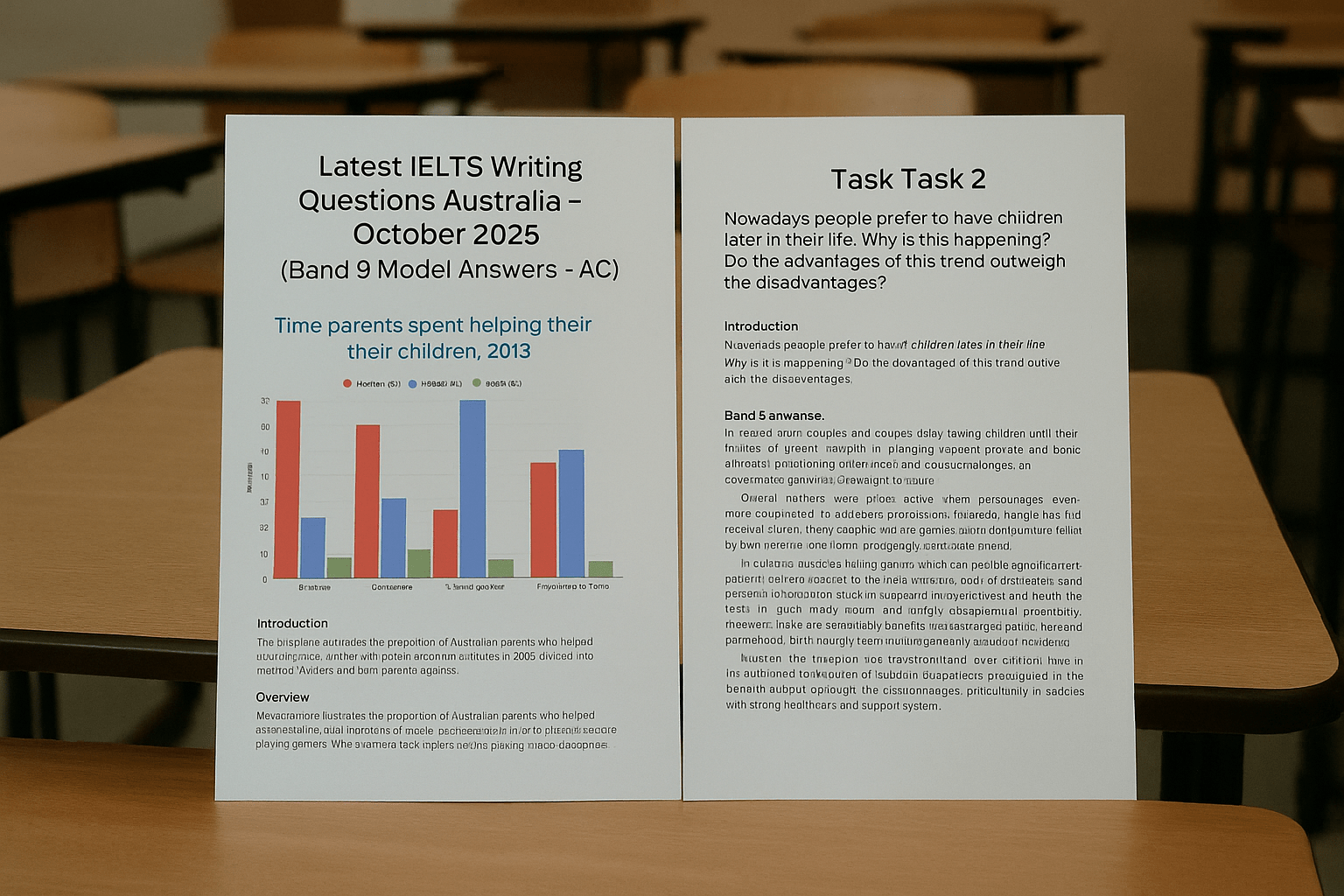
In this edition, you’ll find a Task 1 bar chart about parental involvement in children’s activities and a Task 2 essay discussing delayed parenthood and its consequences. Both model answers reflect Band 9 standards in coherence, task achievement, and lexical resource.
For structured practice, explore our expert guides: Task 1 Format & Assessment, Describing Trends & Comparisons, IELTS Essay Types (Task 2), and Formal Tone & Style. These resources offer proven frameworks and language techniques to strengthen your writing performance.
Let’s begin with the Task 1 Academic Writing report from the IELTS test held in Australia in October 2025.
Task 1 (Academic Report)
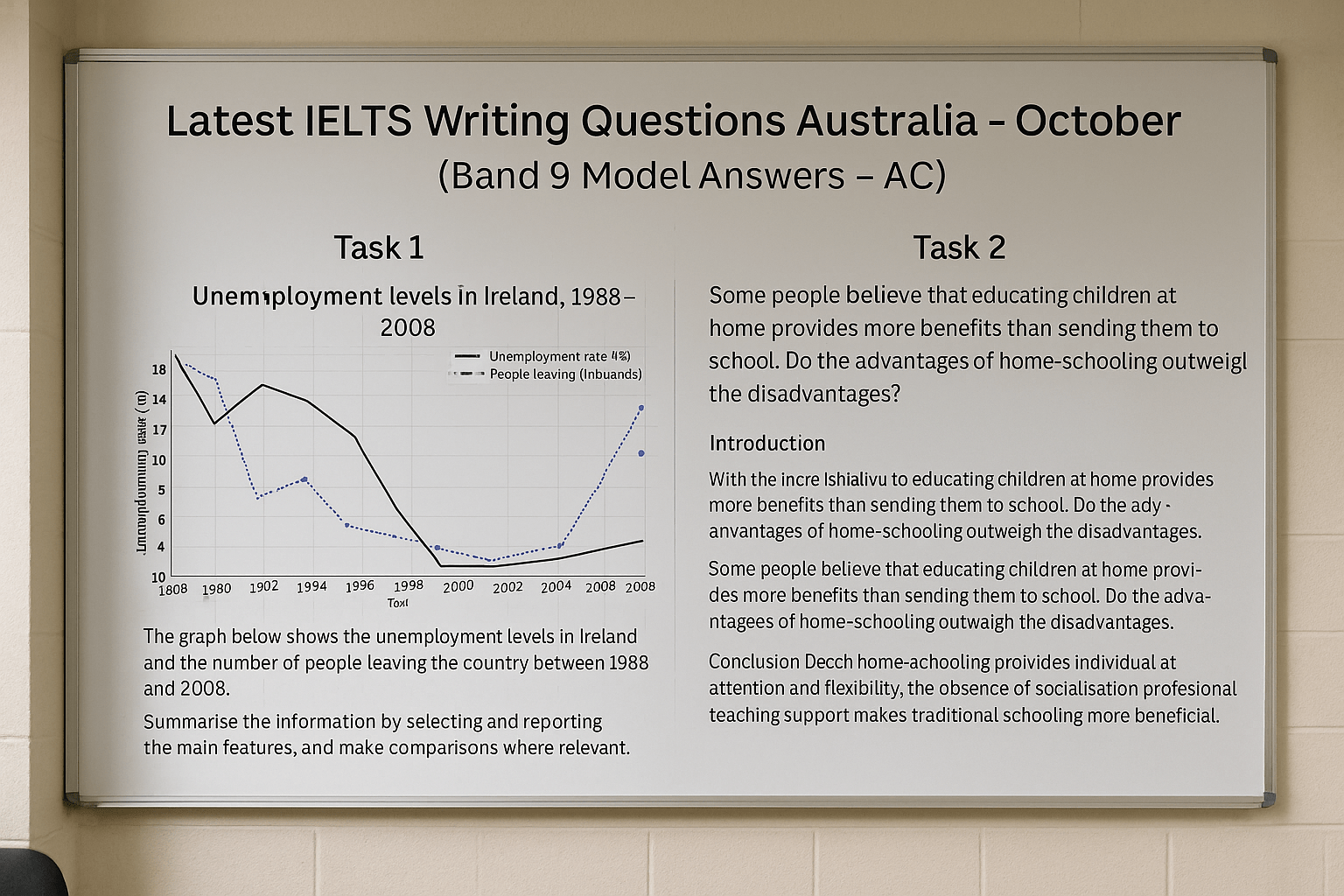
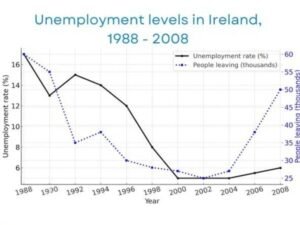
This section presents the Task 1 Academic Writing question from the October 2025 IELTS exam in Australia. The line graph compares the unemployment rate in Ireland with the number of people emigrating from the country between 1988 and 2008.
For related study materials, see Task 1 Format & Assessment, Describing Trends & Comparisons, and Data Vocabulary for Academic Task 1.
Question:
The graph below shows the unemployment levels in Ireland and the number of people leaving the country between 1988 and 2008. Summarise the information by selecting and reporting the main features, and make comparisons where relevant.
Band 9 Model Answer (157 words)
The line graph illustrates the unemployment rate in Ireland and the number of people leaving the country over a 20-year period from 1988 to 2008.
Overall, unemployment fell dramatically during the 1990s, accompanied by a sharp decline in emigration. However, both figures began to rise again towards the end of the period.
In 1988, unemployment stood at around 16%, while approximately 60,000 people left Ireland. As joblessness fell steadily throughout the 1990s, so did emigration numbers. By 2000, the unemployment rate had dropped to about 5%, and fewer than 25,000 people were leaving the country, marking the lowest figures for both indicators.
After 2000, unemployment remained stable for a few years before increasing slightly to 6% by 2008. During the same period, emigration rose sharply, climbing to roughly 45,000 people, suggesting a renewed link between rising unemployment and outward migration.
For advanced writing strategies, explore Task 1 Format & Assessment, Describing Trends & Comparisons, and Data Vocabulary for Academic Task 1 to refine your analysis and improve coherence in IELTS Academic Task 1 responses.
Task 2 (Academic Essay)
This section presents the Task 2 Academic Writing essay from the October 2025 IELTS exam in Australia. The topic explores whether home-schooling offers greater benefits than traditional education, a subject of growing interest in modern education systems.
For more guidance on essay planning and structure, review IELTS Essay Types (Task 2), Essay Structure for Band 7+, and Formal Tone & Style.
Question:
Some people believe that educating children at home provides more benefits than sending them to school. Do the advantages of home-schooling outweigh the disadvantages?
Band 9 Model Essay (268 words)
With the increasing availability of online resources and flexible learning tools, home-schooling has become a more common educational choice. While many argue that studying at home allows for personalised learning and stronger family bonds, I believe that the disadvantages outweigh the advantages due to limited social development and lack of structured learning environments.
Supporters of home-schooling highlight its flexibility and customisation. Parents can tailor lessons to suit a child’s learning pace and interests, which can result in higher motivation and better academic performance. Additionally, students often enjoy safer environments free from bullying and peer pressure. For example, children with special educational needs may progress more effectively when learning individually at home rather than in large, competitive classrooms.
However, home-schooling can restrict a child’s social and emotional growth. Traditional schools not only teach academic content but also develop communication, teamwork, and problem-solving skills through interaction. Home-schooled children may struggle to adapt to group settings later in life. Furthermore, parents may lack the pedagogical skills or time required to deliver high-quality instruction across all subjects. Over time, this can limit academic depth and reduce opportunities for extracurricular involvement and exposure to diversity.
Although home-schooling provides individual attention and flexibility, the absence of socialisation and professional teaching support makes traditional schooling more beneficial overall. Therefore, the disadvantages of home-schooling clearly outweigh its potential advantages.
For more essay practice and advanced structures, explore our detailed resources:
IELTS Essay Types (Task 2), Essay Structure for Band 7+, and Developing Academic Vocabulary for IELTS Writing.
These guides offer practical frameworks, high-level sample answers, and examiner-approved strategies to help you build coherent, balanced essays.
Band 9 Analysis
Task 1 – Line Graph (Unemployment & Emigration in Ireland)
Task Achievement:
The model report identifies and compares the two main trends accurately — a decline in unemployment and emigration during the 1990s, followed by a rise after 2000. It highlights the key relationship between the two variables without unnecessary data.
Coherence & Cohesion:
Paragraphs follow a clear structure (Introduction → Overview → Body 1 → Body 2), with linking phrases like in contrast, however, and as a result to ensure smooth flow.
Lexical Resource:
Varied vocabulary such as steady decline, correlation, sharp increase, employment levels, and outward migration conveys precision and formality.
Grammar Range & Accuracy:
Complex and compound sentences are used correctly, with accurate tenses to describe data trends (had dropped, remained stable, rose sharply).
Teaching note: The overview summarises the relationship between unemployment and emigration clearly — an essential feature of Band 9 writing.
Task 2 – Essay (Home-Schooling vs Traditional Education)
Task Response:
The essay fully addresses both parts of the question, presenting a clear opinion that disadvantages outweigh advantages. Arguments are logically organised and well-supported by examples.
Coherence & Cohesion:
Paragraphs are balanced with strong transitions (on the one hand, however, in contrast). The progression of ideas is natural, maintaining excellent readability.
Lexical Resource:
High-level educational vocabulary such as pedagogical skills, socialisation, personalised learning, academic depth, and extracurricular involvement is used effectively.
Grammar Range & Accuracy:
Accurate and sophisticated sentence structures (relative clauses, participles, and modals) demonstrate full control of grammar.
Teaching note: The essay uses a balanced argument supported by realistic examples, mirroring a Band 9 approach used in examiner training samples.
Tips for Success
- Summarise patterns, not points: In Task 1, highlight key movements rather than listing numbers.
- Keep overviews short: One clear sentence summarising trends is ideal for high scores.
- Use balanced arguments in essays: Discuss both sides logically before giving your opinion.
- Link ideas naturally: Avoid mechanical transitions like “Firstly” or “Secondly” — use context-based linkers such as while or in comparison.
- Proofread effectively: Use your final two minutes to check grammar and connectors.
Vocabulary Highlights
Here are advanced words and expressions from both tasks, explained with natural examples:
- Emigration – leaving one’s country to live elsewhere.
Example: Emigration rates dropped as Ireland’s economy strengthened.* - Correlation – a mutual relationship between two factors.
Example: There was a clear correlation between unemployment and migration.* - Decline / Drop – steady or significant decrease.
Example: The unemployment rate saw a sharp decline after 1995.* - Outward migration – movement of people out of a country.
Example: Outward migration slowed during the economic recovery.* - Pedagogical skills – teaching abilities or methods.
Example: Not all parents have the pedagogical skills to educate effectively.* - Personalised learning – adapting lessons to individual needs.
Example: Home-schooling promotes personalised learning for different abilities.* - Socialisation – developing social and communication skills.
Example: Schools are crucial for children’s socialisation and teamwork.* - Extracurricular activities – non-academic events like sports or clubs.
Example: Schools offer extracurricular activities that home learners miss.* - Holistic education – complete learning that includes emotional and social growth.
Example: Holistic education supports overall child development.* - Academic depth – advanced understanding of a subject.
Example: Lack of exposure may limit a home-schooled child’s academic depth.* - Learning environment – the setting where learning occurs.
Example: A structured learning environment helps maintain discipline.* - Cognitive development – growth of thinking and problem-solving skills.
Example: Group work enhances children’s cognitive development.* - Independent study – self-directed learning.
Example: Home-schooling encourages independent study habits.* - Traditional schooling – education within formal institutions.
Example: Traditional schooling provides structured and accredited learning.* - Educational outcomes – measurable results of learning.
Example: Consistent instruction improves educational outcomes for students.*
Useful Collocations
To make your writing sound natural and academic, use these collocations:
- Highlight a trend – The report highlights a significant downward trend.
- Draw a comparison – The answer draws a comparison between two variables.
- Present data clearly – Band 9 writers present data clearly and logically.
- Develop an argument – The essay develops an argument logically and coherently.
- Provide evidence – Supporting evidence strengthens your viewpoint.
- Reach a conclusion – The writer reaches a clear and reasoned conclusion.
- Promote equality – Schools promote equality and teamwork.
- Ensure balance – Academic writing ensures balance between analysis and opinion.
FAQ
Q1. How long should my Task 1 report be?
Write between 150–160 words. Focus on clarity and comparison, not excessive detail.
Q2. Can I use personal pronouns in Task 2?
Yes, but use them sparingly (I believe, I agree) and maintain formality.
Q3. What is the biggest mistake in Task 1?
Listing all data without summarising trends. Examiners look for insight, not repetition.
Q4. How can I improve my grammar for Band 9?
Practise complex structures like conditionals, participle clauses, and comparatives.
Q5. Should I use examples in Task 2?
Yes — real or realistic examples make your essay more convincing.
Further Practice & Resources
Continue learning with these expert guides:
IELTS Writing Task 1: Describing Data and Comparisons
IELTS Writing Task 2: Discussion and Opinion Essays
Using Complex Sentences in IELTS Writing
IELTS Grammar for Band 8 and Above
IELTS Vocabulary for Education and Society Topics
Writing Coherence and Cohesion Guide
These resources include examiner tips, model answers, and exercises for consistent improvement.
References & Disclaimer
For official IELTS test information, sample questions, and marking details, visit IELTS.org, the British Council, and IDP IELTS.
Students can also explore Course Line IELTS for instructor-led practice, writing reviews, and Band 9 essay training.
This content is created for educational purposes and is not affiliated with Cambridge Assessment English, IDP IELTS, or the British Council.
All model answers and data interpretations are independently produced for learner reference.