I’m Sarah Thompson, an IELTS Writing instructor with over 15 years of experience helping students reach Band 8 and above. In this guide to the Latest IELTS Writing Questions Australia, you’ll find authentic Band 9 model answers, examiner-style analysis, and expert strategies for mastering the Academic Writing (AC) module in the October 2025 test.
For a full global overview of this year’s Academic Writing tasks, visit our master post: Latest IELTS Writing Questions 2025 (Band 9 Model Answers – AC)
Welcome to the Latest IELTS Writing Questions Australia – October 2025 (Academic Module) guide. This article presents the most recent IELTS Academic Writing questions reported by candidates in Australia, featuring Band 9 model answers, detailed feedback, and practical exam advice.
The Academic Writing Test is divided into two key parts:
- Task 1 – a data report describing visual information such as a table, chart, or graph.
- Task 2 – a formal essay that tests your ability to present ideas clearly, logically, and persuasively.
In this edition, you’ll explore genuine IELTS questions from the October 2025 test in Australia, including a Task 1 data report and a Task 2 opinion essay, both crafted to meet Band 9 descriptors in task achievement, coherence, and lexical precision.
For further preparation, explore our expert guides: Task 1 Format & Assessment, Describing Trends & Comparisons, IELTS Essay Types (Task 2), and Formal Tone & Style. These resources will help you strengthen your sentence structure, analytical skills, and vocabulary range for top-band performance.
Let’s begin with the Task 1 Academic Writing report from the IELTS exam held in Australia (October 2025).
Task 1 (Academic Report)
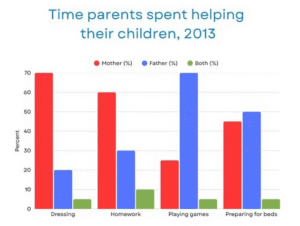
This section presents the Task 1 Academic Writing question from the October 2025 IELTS exam in Australia. The bar chart compares how much time Australian mothers and fathers devoted to helping their children with four home activities in 2013: dressing, homework, playing games, and preparing for bed.
For related resources, see Task 1 Format & Assessment, Describing Trends & Comparisons, and Data Vocabulary for Academic Task 1.
Question:
The chart below shows the percentages of time Australian mothers and fathers spent helping their children with four activities at home in 2013. Summarise the information by selecting and reporting the main features, and make comparisons where relevant.
Band 9 Model Answer (159 words)
The bar chart illustrates the proportion of Australian parents who helped their children with four different household activities in 2013, divided into mothers, fathers, and both parents together.
Overall, mothers were more involved than fathers in most activities, except for playing games, where fathers took the lead. Joint participation by both parents was relatively low across all categories.
Around 70% of mothers assisted their children with dressing, compared to only 20% of fathers. A similar pattern appeared in helping with homework, where about 60% of mothers and 30% of fathers were involved. Only a small proportion, roughly 5–10%, of both parents helped together in these tasks.
In contrast, fathers were more active in playing games (70%) than mothers (25%). For preparing for bed, parental involvement was fairly balanced, at around 45% for mothers and 50% for fathers. Joint participation in these activities remained minimal.
For deeper understanding, explore Task 1 Format & Assessment, Describing Trends & Comparisons, and Data Vocabulary for Academic Task 1 to learn how to structure reports effectively and describe visual data accurately.
Task 2 (Academic Essay)
This section presents the Task 2 Academic Writing essay from the October 2025 IELTS exam in Australia. The topic explores why many people are choosing to have children later in life, and whether this trend brings more benefits than drawbacks.
For essay planning and structure guidance, review IELTS Essay Types (Task 2), Essay Structure for Band 7+, and Formal Tone & Style.
Question:
Nowadays people prefer to have children later in their life. Why is this happening? Do the advantages of this trend outweigh the disadvantages?
Band 9 Model Essay (269 words)
In recent years, it has become increasingly common for individuals and couples to delay having children until their thirties or even forties. This shift is primarily due to changing lifestyle priorities and economic pressures. Although postponing parenthood may cause some challenges, I believe the advantages generally outweigh the disadvantages.
One major reason for delayed parenthood is the pursuit of higher education and career advancement. Many young adults prefer to focus on building stable careers and financial security before starting a family. In addition, modern women often prioritise education and professional success, leading to later marriages and childbirth. For example, in Australia, government data show that the average age for first-time mothers has risen above 30. This reflects a broader social change towards greater independence and gender equality.
Having children later in life can provide significant benefits. Older parents tend to be more emotionally mature, financially prepared, and capable of providing better opportunities for their children. Stable employment and accumulated life experience often lead to healthier family environments. However, there are potential drawbacks, such as reduced fertility and health risks for older mothers, as well as a smaller generational gap that might affect energy levels and family dynamics. Despite these, medical advancements and improved healthcare options now help minimise such risks.
Overall, the trend of having children later in life is a natural outcome of modern lifestyles and greater career ambitions. Its benefits — including emotional stability and financial readiness — largely outweigh the disadvantages, particularly in societies with strong healthcare and support systems.
To improve your Task 2 writing, explore IELTS Essay Types (Task 2), Essay Structure for Band 7+, and Developing Academic Vocabulary for IELTS Writing. These guides include frameworks, sample essays, and key vocabulary for expressing complex ideas clearly and logically.
Band 9 Analysis
Task 1 – Bar Chart (Parental Involvement in Childcare)
Task Achievement:
The response covers all key features, making accurate comparisons and highlighting contrasts between mothers’ and fathers’ involvement. The overview clearly summarises general trends — mothers were more active except in playing games.
Coherence & Cohesion:
Logical flow and paragraphing follow the Band 9 structure (Introduction → Overview → Body 1 → Body 2). Linking phrases such as in contrast, whereas, and a similar pattern are used appropriately.
Lexical Resource:
A wide range of precise academic expressions: parental involvement, proportion, household activities, joint participation, balanced division of roles.
Grammar Range & Accuracy:
Excellent use of comparatives and complex sentence forms, e.g., while mothers devoted more time to dressing, fathers were more active in playing games.
Teaching note: The overview highlights major differences and avoids unnecessary data, demonstrating strong summarising skill — key to Band 9.
Task 2 – Essay (Delayed Parenthood)
Task Response:
Fully addresses both parts of the question (reasons and evaluation). The stance is clear throughout, and arguments are well-supported with logical explanations and relevant examples.
Coherence & Cohesion:
Paragraphs are balanced, transitions smooth, and ideas progress naturally using linkers like in addition, however, and as a result.
Lexical Resource:
Advanced vocabulary for social and demographic topics (fertility rates, career advancement, financial readiness, life expectancy). Word choice is precise and academic.
Grammar Range & Accuracy:
Wide grammatical control with complex and compound sentences, passive structures, and correct article usage.
Teaching note: The essay achieves an excellent balance — analytical yet personal — a common trait of Band 9 writing.
Tips for Success
- Plan before you write: Spend 3–4 minutes outlining ideas for both tasks.
- Write a clear overview in Task 1: Summarise trends without numbers.
- Stay formal and objective: Avoid personal opinions in Task 1; use measured tone in Task 2.
- Use precise linkers: Replace repetitive words like “also” with “in addition,” “moreover,” or “likewise.”
- Proofread at the end: Check verb tenses, plural forms, and comparative structures.
Vocabulary Highlights
Use these high-level words and phrases naturally in your IELTS Writing responses:
- Parental involvement – participation of parents in children’s daily activities.
Example: Parental involvement was highest among mothers in all categories. - Proportion – part or share of a whole.
Example: A higher proportion of mothers assisted with dressing. - Balanced division – equal distribution of responsibility.
Example: Preparing for bed showed a more balanced division between parents. - Fertility rate – measure of birth frequency.
Example: Declining fertility rates reflect delayed parenthood trends. - Economic stability – secure financial situation.
Example: Couples often delay childbirth to achieve economic stability. - Gender equality – equal treatment and opportunity for all genders.
Example: Rising gender equality has encouraged more women to prioritise careers. - Societal shift – gradual change in social attitudes.
Example: Delayed parenting represents a major societal shift. - Emotional maturity – psychological readiness.
Example: Older parents bring greater emotional maturity to child-rearing. - Demographic change – variation in population patterns.
Example: This demographic change influences national education planning. - Financial preparedness – having adequate resources for family life.
Example: Financial preparedness is a common reason for postponing parenthood. - Healthcare advancement – progress in medical treatment and safety.
Example: Healthcare advancements allow older parents to conceive safely. - Work-life balance – managing work and family responsibilities.
Example: Later parenthood can improve work-life balance for young professionals. - Generational gap – difference in age and lifestyle between parents and children.
Example: A smaller generational gap may affect shared activities. - Urban lifestyle – way of life in modern city environments.
Example: The urban lifestyle encourages later marriage and childbirth. - Reproductive health – physical wellbeing related to fertility.
Example: Improved reproductive health has made later childbirth possible.
Useful Collocations
Use these natural combinations to elevate coherence and accuracy:
- Highlight a trend – The chart highlights a gender-based trend.
- Draw a comparison – The writer draws a comparison between mothers and fathers.
- Show a contrast – The report shows a contrast in parenting roles.
- Pursue a career – Many adults delay children to pursue careers.
- Achieve stability – Couples prefer to achieve financial stability first.
- Raise a family – People choose to raise a family later in life.
- Manage responsibilities – Older parents manage responsibilities more effectively.
- Balance priorities – Modern lifestyles require balancing professional and personal priorities.
FAQ
Q1. Do I need to include exact percentages in Task 1?
Only when they help highlight a comparison or major difference. Avoid listing every number.
Q2. Can I use personal pronouns in Task 2?
Yes, but sparingly. Use I believe or I agree only once or twice.
Q3. How long should my Task 1 be?
Between 150–160 words — concise, clear, and analytical.
Q4. How can I improve vocabulary range?
Read sample IELTS model answers and note topic-specific academic words.
Q5. What’s the most common mistake in Task 2?
Repeating ideas without supporting them with examples or logical explanation.
Further Practice & Resources
Build your writing skills with these focused guides:
IELTS Writing Task 1: Describing Data and Comparisons,
IELTS Writing Task 2: Advantage–Disadvantage Essays,
Using Complex Sentences in IELTS Writing,
IELTS Grammar for Band 8 and Above,
IELTS Vocabulary for Family and Lifestyle Topics,
and Writing Coherence and Cohesion Guide.
These resources offer frameworks, model essays, and language strategies to help you consistently achieve Band 8–9 scores.
References & Disclaimer
For official IELTS exam information, scoring criteria, and practice materials, visit IELTS.org, the British Council, and IDP IELTS.
Students can also explore Course Line IELTS for structured lessons, examiner-reviewed feedback, and topic-based writing exercises.
This article is created for educational purposes only and is not affiliated with Cambridge Assessment English, IDP IELTS, or the British Council. All examples and model answers are independently developed to illustrate Band 9 writing quality.