I’m Sarah Thompson, an IELTS Writing instructor with over 15 years of experience helping learners achieve Band 8 and above. In this guide to the Latest IELTS Writing Questions Saudi Arabia, you’ll find Band 9 model answers, expert analysis, and targeted strategies to improve your Academic Writing (AC) performance in the October 2025 test.
For a full global overview of this year’s Academic Writing tasks, visit our master post: Latest IELTS Writing Questions 2025 (Band 9 Model Answers – AC)
Welcome to the Latest IELTS Writing Questions Saudi Arabia – October 2025 (Academic Module) guide. This article features the most recent IELTS Academic Writing tasks reported by candidates in Saudi Arabia, along with Band 9 model answers, detailed explanations, and professional tips to help you perform confidently on test day.
The Academic Writing Test consists of two parts:
- Task 1, which involves describing data or trends shown in a chart, table, or graph.
- Task 2, a formal essay requiring structured argument and clear expression of ideas.
In this edition, you’ll explore authentic Task 1 and Task 2 questions from the October 2025 exam session, written in a formal academic tone and evaluated using IELTS Band 9 descriptors.
For more focused preparation, review our expert guides on Task 1 Format & Assessment, Describing Trends & Comparisons, IELTS Essay Types (Task 2), and Formal Tone & Style. These resources will strengthen your understanding of structure, coherence, and vocabulary across both tasks.
Let’s begin with the Task 1 Academic Writing question from the IELTS exam in Saudi Arabia (October 2025).
Task 1 (Academic Report)
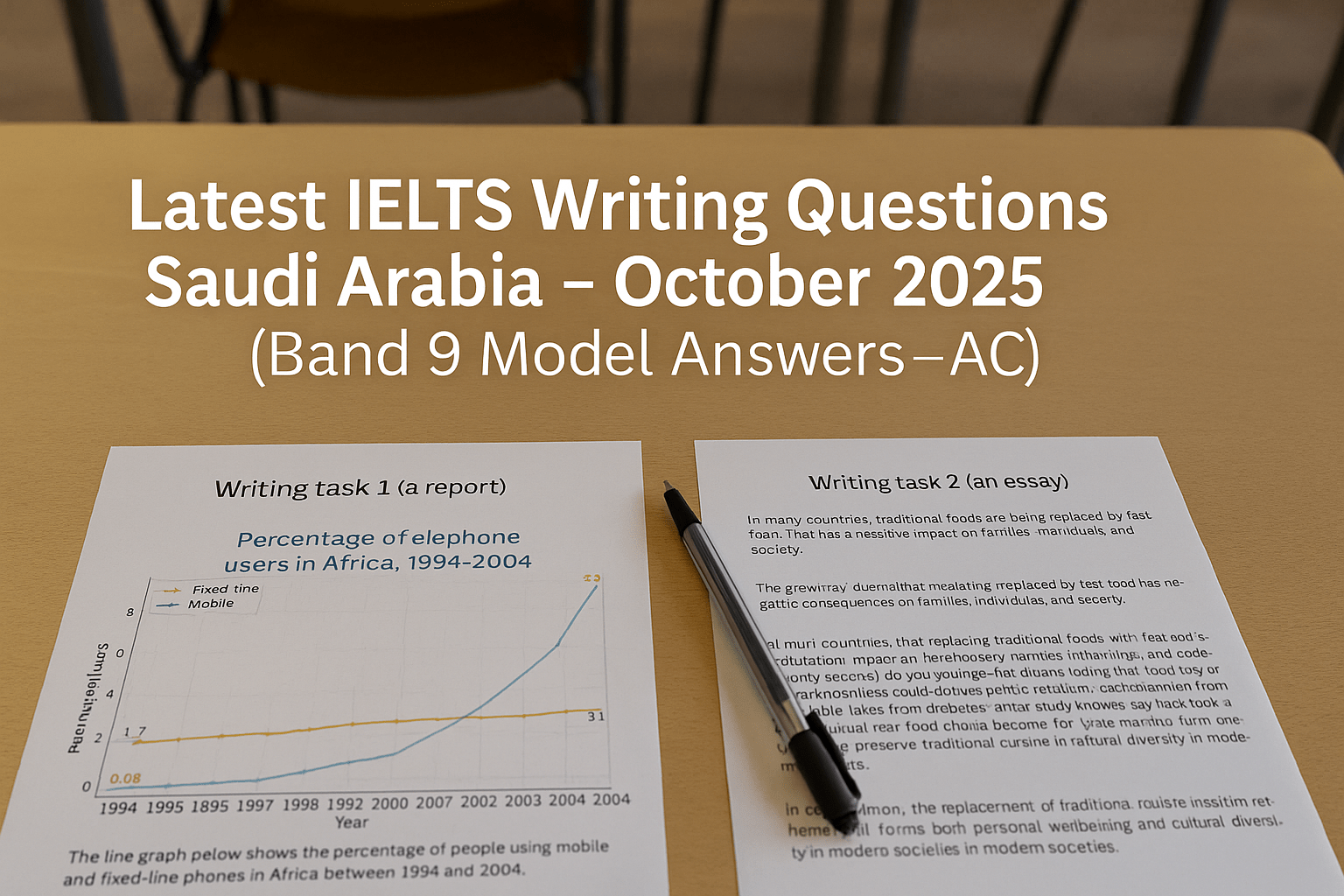
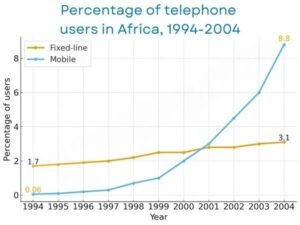
This section presents the Task 1 Academic Writing question from the October 2025 IELTS exam in Saudi Arabia. The data compares the percentage of people using mobile and fixed-line phones in Africa between 1994 and 2004, highlighting contrasting growth patterns.
For structured guidance, review Task 1 Format & Assessment, Describing Trends & Comparisons, and Data Vocabulary for Academic Task 1.
Question:
The line graph below shows the percentage of people using mobile and fixed-line phones in Africa between 1994 and 2004. Summarise the information by selecting and reporting the main features, and make comparisons where relevant.
Band 9 Model Answer (158 words)
The line graph illustrates changes in the percentage of people using mobile and fixed-line telephones in Africa from 1994 to 2004.
Overall, while fixed-line usage rose gradually, mobile phone use increased dramatically and overtook fixed-line connections after 1999.
In 1994, only 0.06% of Africans used mobile phones, compared to around 1.7% using fixed lines. Mobile use remained minimal until 1998, after which it began rising sharply. By 2000, mobile subscriptions equalled fixed-line levels at roughly 2%, and this figure continued to soar to almost 9% by 2004.
In contrast, fixed-line usage grew slowly and steadily throughout the period. Starting at 1.7%, it climbed to just over 3% by 2004. This modest increase was far smaller than the explosive growth in mobile use, which became the dominant form of telephone communication by the end of the decade.
For advanced writing improvement, explore Task 1 Format & Assessment, Describing Trends & Comparisons, and Data Vocabulary for Academic Task 1. These guides offer practical methods for structuring overviews, describing data accurately, and using precise comparative language.
Task 2 (Academic Essay)
This section explores the Task 2 Academic essay from the October 2025 IELTS test in Saudi Arabia. The topic discusses how traditional diets are being replaced by fast food, raising concerns about its effects on health, family life, and culture.
For strong essay planning and structure, review IELTS Essay Types (Task 2), Essay Structure for Band 7+, and Formal Tone & Style.
Question:
In many countries, traditional foods are being replaced by fast food. This has a negative impact on families, individuals, and society.
To what extent do you agree or disagree?
Band 9 Model Essay (266 words)
The growing popularity of fast food has transformed eating habits around the world. While some believe this shift offers convenience and affordability, I strongly agree that replacing traditional foods with fast food has negative consequences for individuals, families, and society as a whole.
At the individual level, fast food contributes to serious health issues such as obesity and heart disease. Traditional diets, often rich in natural ingredients, provide balanced nutrition, whereas fast food is typically high in fat, sugar, and salt. For example, studies in the Middle East show that younger generations who consume fast food regularly are more likely to suffer from diabetes compared with those following traditional diets. This shift not only weakens physical health but also reduces awareness of local culinary culture.
From a social perspective, the decline of traditional meals erodes family and community bonds. Shared home-cooked meals once encouraged communication and strengthened relationships, whereas fast food promotes quick, individual eating. In the long term, this can lead to cultural homogenisation, where people lose appreciation for regional dishes that reflect national identity. Furthermore, multinational fast-food chains dominate local markets, discouraging small businesses and traditional restaurants from surviving.
In conclusion, the replacement of traditional foods by fast food harms both personal wellbeing and cultural values. Preserving traditional cuisine is essential to maintaining family unity, public health, and cultural diversity in modern societies.
For further essay practice, read our resources on IELTS Essay Types (Task 2), Essay Structure for Band 7+, and Developing Academic Vocabulary for IELTS Writing. These guides provide practical frameworks and examples to help you build coherent arguments and refine your lexical range.
Band 9 Analysis
Task 1 – Line Graph Report
Task Achievement: The answer fully describes key trends between 1994 and 2004 and makes precise comparisons between mobile and fixed-line phone usage.
Coherence & Cohesion: The report is clearly organised into an introduction, overview, and two body paragraphs. Linking devices such as in contrast, while, and by comparison ensure smooth flow.
Lexical Resource: High-level expressions like overtook, steady increase, and dominant form of communication are used naturally.
Grammar Range & Accuracy: Complex and compound sentences are accurate and varied.
Teaching note: The overview summarises the main patterns without listing all figures, which is essential for Band 9 writing.
Task 2 – Essay
Task Response: The essay presents a clear stance and develops arguments logically with relevant examples.
Coherence & Cohesion: Paragraphs are well balanced; connectors such as whereas, in the long term, and furthermore maintain cohesion.
Lexical Resource: Excellent use of academic vocabulary (cultural homogenisation, culinary heritage, nutritional balance).
Grammar Range & Accuracy: Flawless use of complex clauses and accurate tense control.
Teaching note: Balanced reasoning, formal tone, and precise vocabulary reflect Band 9 proficiency.
Tips for Success
- Plan your overview first: Identify the main trend before writing.
- Use varied linkers: Avoid repeating however or also; use whereas, while, or in contrast.
- Stay formal: Replace casual expressions with academic phrasing.
- Support arguments with evidence: Use logical examples, not personal stories.
- Proofread for grammar and cohesion: Check articles, punctuation, and sentence flow.
Vocabulary Highlights
Below are key academic words and expressions from the Task 1 and Task 2 samples. Use them naturally in your IELTS Writing tasks:
- Overtake – to become greater than or more successful than something else. Example: Mobile phone usage overtook fixed-line services after 1999.
- Gradual increase – slow but steady growth. Example: There was a gradual increase in fixed-line connections.
- Dominant – most influential or common. Example: Mobile communication became the dominant form of telephony.
- Nutritional balance – the right combination of nutrients in food. Example: Traditional diets provide better nutritional balance.
- Cultural homogenisation – loss of unique traditions due to global influence. Example: Fast food leads to cultural homogenisation in many societies.
- Culinary heritage – traditional food culture of a region. Example: Preserving culinary heritage helps maintain cultural identity.
- Convenience culture – lifestyle focused on quick and easy solutions. Example: Fast food has encouraged a global convenience culture.
- Affordability – being cheap or easy to afford. Example: The affordability of fast food attracts young consumers.
- Health implications – possible effects on wellbeing. Example: The health implications of fast food consumption are serious.
- Wellbeing – a state of being comfortable and healthy. Example: Healthy eating contributes to overall wellbeing.
- Erode – to weaken or reduce gradually. Example: Fast food erodes traditional family mealtime values.
- Sustainability – ability to be maintained over time. Example: Traditional diets promote environmental sustainability.
- Dietary shift – a change in eating habits. Example: A dietary shift toward processed food is noticeable globally.
- Cultural identity – a sense of belonging to a particular culture. Example: Traditional cuisine strengthens cultural identity.
- Societal impact – influence on communities or social systems. Example: The societal impact of fast food includes rising health costs.
Useful Collocations
Use these combinations to sound more natural and academic:
- Highlight a trend – The report highlights a clear trend over time.
- Draw a comparison – The graph draws a comparison between two variables.
- Support an argument – Reliable data can support an argument effectively.
- Maintain coherence – Logical transitions maintain coherence across ideas.
- Express a viewpoint – Candidates must clearly express a viewpoint in essays.
- Demonstrate understanding – Complex sentence use demonstrates grammatical understanding.
- Preserve traditions – Governments should preserve traditions through education.
- Address a concern – The essay addresses a growing concern about health.
FAQ
Q1. Should I include every figure in Task 1?
No. Focus on main patterns and comparisons rather than minor details.
Q2. Can I use “I think” or “I believe” in Task 2?
Yes, but keep the tone formal and consistent.
Q3. How long should Task 1 and Task 2 be?
Task 1: 150–160 words; Task 2: 260–280 words.
Q4. Can I mix tenses in Task 1?
Use past tense for completed periods, but mix with present when describing current relevance.
Q5. How can I improve coherence?
Plan your paragraph order and use linking words appropriately without overuse.
Further Practice & Resources
Enhance your writing with these expert guides:
IELTS Writing Task 1: Describing Data and Comparisons,
IELTS Writing Task 2: Opinion and Discussion Essays,
Using Complex Sentences in IELTS Writing,
IELTS Grammar for Band 8 and Above,
IELTS Vocabulary for Food and Culture Topics,
and Writing Coherence and Cohesion Guide.
These resources provide structured examples, frameworks, and practice exercises to help you strengthen your Academic Writing skills.
References & Disclaimer
For official information about IELTS exams and scoring criteria, visit IELTS.org, the British Council, and IDP IELTS websites. Learners can also explore Course Line IELTS for structured training, model responses, and examiner-reviewed feedback.
This article is intended for educational use only and is not affiliated with Cambridge Assessment English, IDP IELTS, or the British Council. All sample tasks and answers are independently created to illustrate Band 9 performance features for learners and instructors.