I’m Sarah Thompson, an IELTS Writing instructor with over 15 years of experience training students to achieve Band 8 and above. In this guide to the Latest IELTS Writing Questions UK, you’ll find authentic Band 9 model answers, examiner-style feedback, and essential strategies for mastering the Academic Writing (AC) module in the October 2025 test.
For a full global overview of this year’s Academic Writing tasks, visit our master post: Latest IELTS Writing Questions 2025 (Band 9 Model Answers – AC)
Welcome to the New IELTS Questions from the UK – October 2025 (Academic Module). This post presents the most recent IELTS Academic Writing questions reported by candidates in the United Kingdom, along with Band 9 model answers, expert analysis, and vocabulary guidance.
The IELTS Academic Writing Test consists of two key components:
- Task 1 – a report describing visual data such as charts, graphs, or tables.
- Task 2 – a formal essay that tests your ability to express and justify opinions logically.
In this edition, you’ll explore authentic IELTS Writing tasks from the UK’s October 2025 session, showcasing model responses that meet Band 9 criteria in task achievement, coherence, lexical range, and grammar.
To strengthen your preparation, explore our expert resources on Task 1 Format & Assessment, Describing Trends & Comparisons, IELTS Essay Types (Task 2), and Formal Tone & Style. These guides provide practical frameworks and examples to help you structure your responses effectively and use advanced academic vocabulary.
Let’s begin with the Task 1 Academic Writing report from the October 2025 IELTS exam in the UK.
Task 1 (Academic Report)
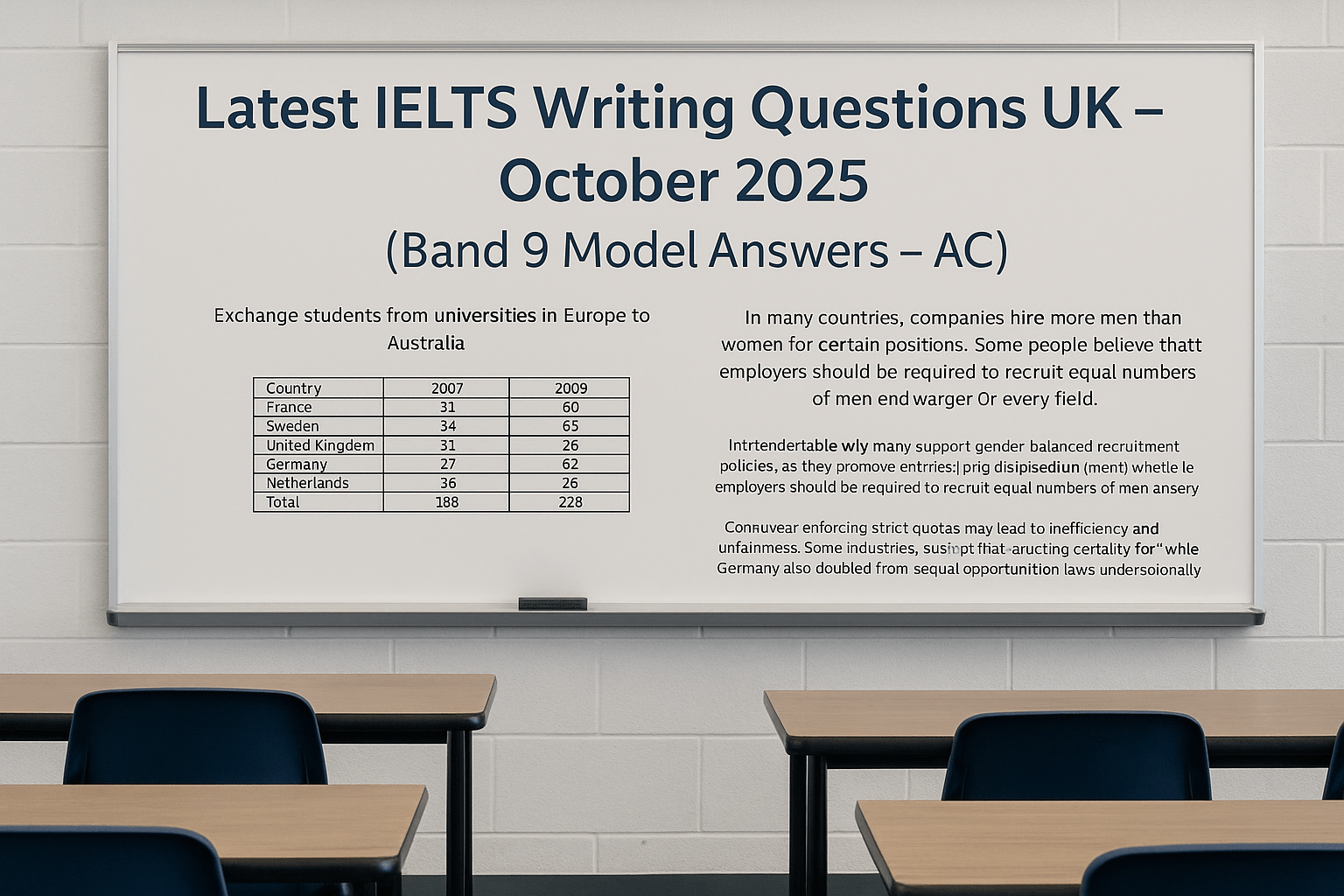
This section presents the Task 1 Academic Writing question from the October 2025 IELTS exam in the UK. The data compares the number of university exchange students travelling between Europe and Australia in 2007 and 2009.
For more help, see Task 1 Format & Assessment, Describing Trends & Comparisons, and Data Vocabulary for Academic Task 1.
Question:
The tables below show the number of exchange students from a university in Europe going to a university in Australia, and the number of exchange students from a university in Australia going to universities in Europe, in the years 2007 and 2009. Summarise the information by selecting and reporting the main features, and make comparisons where relevant.

Band 9 Model Answer (159 words)
The two tables compare the number of exchange students who studied abroad between a European university and Australian universities in 2007 and 2009.
Overall, more students from Europe went to Australia than the other way around in both years. While the total number of European students increased, the number of Australians studying in Europe remained unchanged.
In 2007, 189 European students studied in Australia, rising to 226 two years later. Germany showed the most dramatic increase, from 27 to 62, while numbers from France and the Netherlands stayed roughly constant. Sweden also recorded moderate growth, climbing from 34 to 42, whereas the United Kingdom saw a small decline from 31 to 26.
In contrast, the total number of Australian students going to Europe was 152 in both years. The most significant rise was in France, from 37 to 58, while Germany also doubled from 18 to 26. However, the Netherlands and Sweden saw slight decreases.
For advanced practice, explore Task 1 Format & Assessment, Describing Trends & Comparisons, and Data Vocabulary for Academic Task 1 to improve your ability to describe international data and make precise comparisons.
Task 2 (Academic Essay)
This section presents the Task 2 Academic Writing essay from the October 2025 IELTS test in the UK. The question explores whether companies should be legally required to hire equal numbers of men and women, a topic that raises issues of equality, merit, and practicality in the modern workplace.
For detailed writing guidance, review IELTS Essay Types (Task 2), Essay Structure for Band 7+, and Formal Tone & Style.
Question:
In many countries, companies hire more men than women for certain positions. Some people believe that employers should be required to recruit equal numbers of men and women in every field.
To what extent do you agree or disagree?
Band 9 Model Essay (268 words)
Gender equality in the workplace has become a prominent social concern in recent decades. While some argue that employers should be obliged to hire equal numbers of men and women across all fields, I believe that recruitment should be based on merit, qualification, and job suitability rather than fixed quotas.
It is understandable why many support gender-balanced recruitment policies, as they promote fairness and diversity. Equal representation can help dismantle long-standing stereotypes that limit women’s access to leadership and technical roles. For instance, introducing balanced hiring policies in science and engineering has encouraged more women to pursue careers in these fields. Such measures can create inclusive workplaces and send a positive message about social equality.
However, enforcing strict quotas may lead to inefficiency and unfairness. Some industries, such as construction or heavy engineering, naturally attract more male applicants due to physical demands, while healthcare and education may have higher female participation. Employers should prioritise skills and experience rather than gender alone. Moreover, equal opportunity laws already exist in many countries to prevent discrimination, making mandatory gender quotas unnecessary.
Although promoting gender equality is essential, enforcing numerical balance in every field is impractical. Recruitment decisions should focus on competence and fairness rather than legal mandates, allowing both men and women to succeed based on merit.
To refine your essay writing, explore our in-depth guides: IELTS Essay Types (Task 2), Essay Structure for Band 7+, and Developing Academic Vocabulary for IELTS Writing. These resources provide frameworks, examples, and advanced vocabulary to strengthen argumentation and essay coherence.
Band 9 Analysis
Task 1 – Table Report (Exchange Students)
Task Achievement:
The response covers all key features with relevant data and accurate comparisons. It identifies clear trends, such as the increase in European students studying in Australia and the steady total for Australians going to Europe.
Coherence & Cohesion:
Paragraphs are logically structured (intro–overview–two bodies), and connectors such as in contrast, while, and however are used naturally.
Lexical Resource:
Appropriate and varied vocabulary such as steady growth, slight decline, fluctuation, and participant numbers.
Grammar Range & Accuracy:
Wide variety of complex and comparative structures used with precision.
Teaching note: The overview is succinct yet analytical — a consistent Band 9 feature that demonstrates understanding beyond raw data reporting.
Task 2 – Essay (Equal Gender Recruitment)
Task Response:
The essay directly answers the question with a clear, well-balanced opinion. Each argument is developed with logical reasoning and concrete examples.
Coherence & Cohesion:
Ideas flow smoothly from one paragraph to another through cohesive devices like for instance, however, and moreover.
Lexical Resource:
Advanced and topic-relevant vocabulary such as employment equity, diversity policy, recruitment quotas, and inclusive workplaces.
Grammar Range & Accuracy:
Accurate use of passive structures, relative clauses, and modal verbs (should be obliged, may lead to inefficiency).
Teaching note: Balanced argumentation and precise structure reflect a sophisticated command of written English typical of Band 9 writing.
Tips for Success
- Summarise patterns, not numbers: Focus on overall trends and key comparisons in Task 1.
- State your stance clearly: Examiners look for clarity in opinion-based essays.
- Avoid emotional language: Maintain an analytical, academic tone.
- Use paragraph balance: Two strong body paragraphs with distinct points earn higher coherence scores.
- Edit concisely: Ensure grammar accuracy and remove repetitive linkers or filler words.
Vocabulary Highlights
Use these advanced expressions naturally in your IELTS Writing tasks:
- Proportion – a share or part of the total. Example: The proportion of European students in Australia rose steadily.
- Fluctuation – a small change up and down. Example: There was little fluctuation in Australian student numbers.
- Steady growth – slow and continuous increase. Example: The data show steady growth in student exchanges.
- Decline – a decrease or downward trend. Example: The UK experienced a slight decline in outbound students.
- Employment equity – fairness in hiring practices. Example: Employment equity promotes inclusion across industries.
- Gender parity – equal participation of men and women. Example: Many governments aim for gender parity in leadership.
- Workplace diversity – variety in the workforce. Example: Workplace diversity enhances creativity and collaboration.
- Quota system – a rule requiring a specific number of hires. Example: A strict quota system may reduce flexibility.
- Recruitment policy – company strategy for hiring staff. Example: Fair recruitment policies encourage equal opportunity.
- Merit-based selection – hiring based on skills and ability. Example: Merit-based selection ensures fairness and efficiency.
- Inclusion – involvement of all groups. Example: Inclusion is essential for a balanced working culture.
- Stereotype – fixed idea about a group. Example: Hiring quotas help challenge gender stereotypes.
- Legislation – law or legal requirement. Example: Anti-discrimination legislation supports workplace equality.
- Representation – visibility or presence of a group. Example: Equal representation benefits organisational credibility.
- Cultural shift – gradual social change. Example: Achieving gender balance requires a long-term cultural shift.
Useful Collocations
Incorporate these natural academic combinations to enhance fluency:
- Highlight a trend – The table highlights a rise in student exchanges.
- Draw a comparison – The report draws a comparison between two study directions.
- Present data clearly – Band 9 responses present data clearly and logically.
- Promote equality – Governments introduce policies to promote equality.
- Achieve balance – Companies aim to achieve balance between genders.
- Implement policies – Authorities implement policies to encourage diversity.
- Ensure fairness – Merit-based systems ensure fairness in recruitment.
- Encourage participation – Universities encourage participation in exchange programmes.
FAQ
Q1. Should I include all data from the tables in Task 1?
No. Focus only on the main trends, changes, and comparisons that stand out.
Q2. How long should my Task 2 essay be?
Aim for 260–280 words. This allows full idea development without repetition.
Q3. Can I use “I agree” or “I believe”?
Yes, but keep your tone formal and avoid overusing personal pronouns.
Q4. What’s the best way to start Task 1?
Paraphrase the question briefly and mention what the chart or table shows.
Q5. Should I memorise phrases?
Memorise structures (e.g. Overall, it can be seen that…) rather than full sentences to sound natural.
Further Practice & Resources
Continue developing your writing with our professional IELTS resources:
IELTS Writing Task 1: Describing Data and Comparisons,
IELTS Writing Task 2: Opinion and Discussion Essays,
Using Complex Sentences in IELTS Writing,
IELTS Grammar for Band 8 and Above,
IELTS Vocabulary for Work and Equality Topics, and
Writing Coherence and Cohesion Guide.
These provide advanced techniques and model answers to refine your exam performance.
References & Disclaimer
For official information on IELTS exams, marking criteria, and sample materials, visit IELTS.org, the British Council, and IDP IELTS.
Learners can also explore Course Line IELTS for structured lessons, examiner-reviewed writing samples, and vocabulary development resources.
This content is produced purely for educational purposes and is not affiliated with Cambridge Assessment English, IDP IELTS, or the British Council. All tasks and model answers are original examples created to illustrate Band 9-level writing.