I’m Matthew Clarke, an IELTS Speaking Specialist who recently analysed the Latest IELTS Speaking Questions Canada shared by real test-takers from October 2025. With eight years of experience helping learners worldwide achieve Band 7 and above, I focus on fluency, pronunciation, and building natural speaking confidence for exam success.
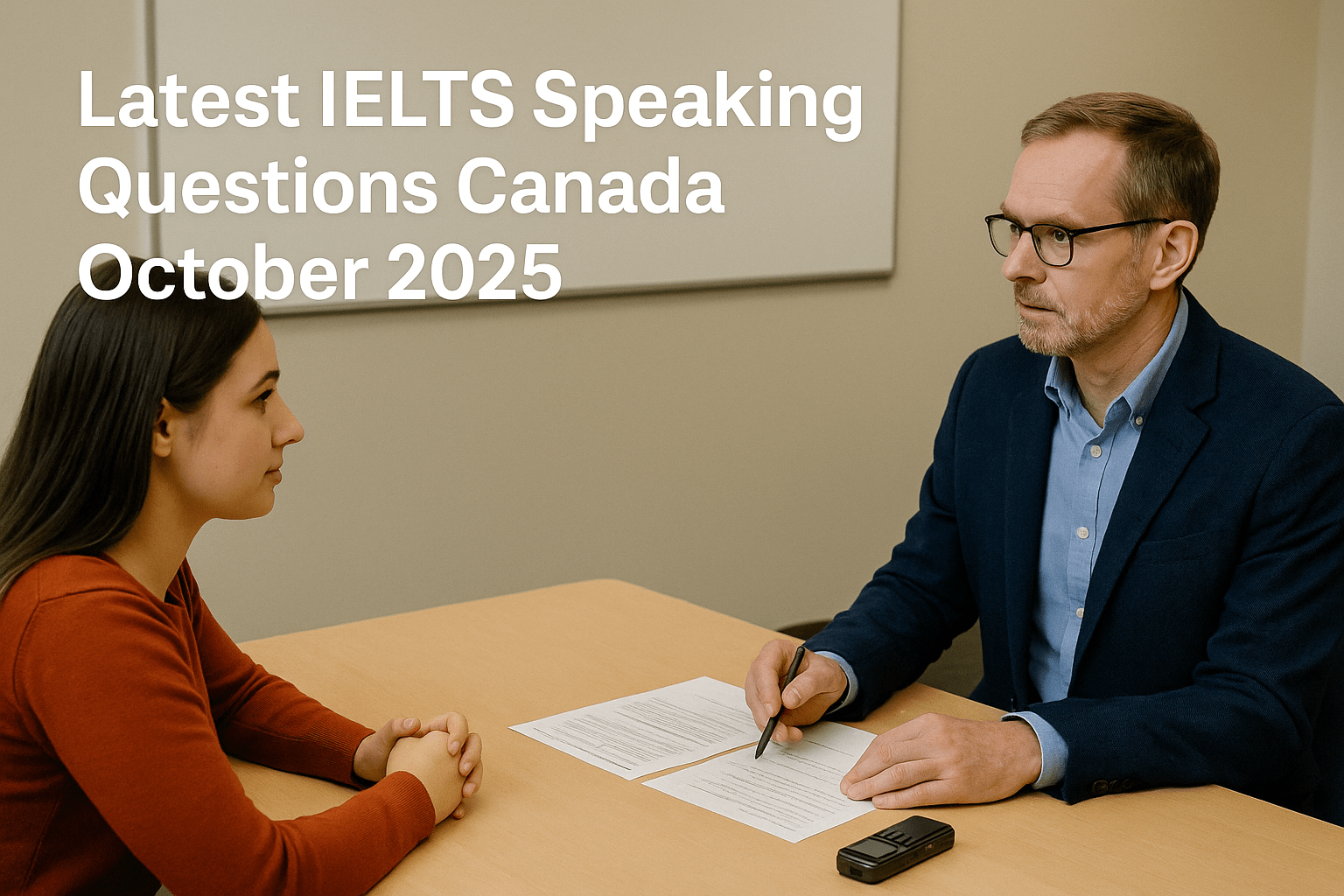
These Latest IELTS Speaking Questions from Canada – October 2025 were recalled by students who recently sat the exam. Exploring authentic question sets helps you recognise current themes, develop topic-specific vocabulary, and practise strategies to speak naturally under exam conditions. For full preparation guides, see our IELTS Speaking Complete Guide.
IELTS Latest Speaking Questions Canada – October 2025
Part 1 – Introduction & Interview
In Part 1 of the IELTS Speaking test, the examiner asks short questions about familiar topics such as home, lifestyle, and free-time habits. This part checks how naturally you respond in everyday English. Read our guide on IELTS Speaking Part 1 Tips.
Do you like to do things well?
Yes, absolutely. I always try to give my best in whatever I do because it makes me feel satisfied and confident. Even small tasks seem more rewarding when I know I’ve done them properly.
Examiner Feedback: Natural tone and full explanation. Complex clause linking (“when I know I’ve done them properly”) → Band 9.
What kinds of things do you try to do perfectly?
I’m quite detail-oriented, so I focus on doing my work and household chores perfectly. For example, when I cook, I measure ingredients carefully because precision makes a big difference in the result.
Examiner Feedback: Specific example + precise vocabulary (“detail-oriented,” “precision”) → Band 9.
How do you feel when you do something successfully?
I feel proud and motivated. It gives me a sense of accomplishment and encourages me to take on bigger challenges in the future.
Examiner Feedback: Strong emotional vocabulary (“sense of accomplishment”) and natural future reference → Band 9.
Do you live in a house or an apartment?
I live in a modern apartment in downtown Toronto. It’s on the tenth floor and has a beautiful view of the city skyline.
Examiner Feedback: Clear noun phrases, spatial detail (“tenth floor,” “skyline”) → Band 9.
Which part of your home do you like the most?
Definitely the living room. It’s bright and spacious, with big windows that let in natural light. It’s where I relax and spend time with friends.
Examiner Feedback: Effective descriptive adjectives (“bright,” “spacious”) and cohesive use of “where” → Band 9.
Is there anything you would like to change about your home?
Yes, I’d love to have a small balcony garden. I think having some greenery would make the place feel more peaceful and refreshing.
Examiner Feedback: Expresses wish clearly; good modal form (“I’d love to have”) → Band 9.
What do you usually do in your free time?
I enjoy reading self-development books or going for walks in the nearby park. They both help me unwind after a busy day.
Examiner Feedback: Clear parallel ideas; idiomatic verb “unwind” → Band 9.
Do you prefer spending your free time alone or with others?
It depends on my mood. When I’m tired, I like quiet time alone, but on weekends I prefer meeting friends for coffee or a movie.
Examiner Feedback: Balanced contrast and cohesive markers (“depends on my mood,” “but on weekends”) → Band 9.
These sample answers show how to respond naturally and extend ideas with examples. Practise more topics on our IELTS Speaking Part 1 Practice Page and build topic vocabulary in our IELTS Speaking Vocabulary Guide.
Part 2 – Cue Card
In Part 2, you’ll receive a topic card and have one minute to prepare before speaking for up to two minutes. This section tests your ability to speak fluently at length and use a wide range of vocabulary. See our IELTS Speaking Part 2 Tips.
Describe a time when you set a goal and achieved it
You should say:
– what the goal was
– when you set it
– what you did to achieve it
and explain how you felt when you achieved it.
Sample Band 9 Answer
I’d like to talk about a goal I set last year to improve my fitness and run a half marathon. I decided to do it in January and gave myself six months to train. At first, it was really challenging because I wasn’t used to running long distances, but I created a training schedule and followed it strictly.
I woke up early every morning to run and gradually increased my distance each week. There were days when I felt like giving up, especially when the weather was bad, but I kept reminding myself of how good it would feel to cross the finish line. Finally, in June, I completed the race and finished in just under two hours. It was one of the most satisfying moments of my life.
Achieving that goal taught me discipline and consistency. I felt proud not only of the result but of the journey itself because I proved to myself that I could achieve anything with focus and determination.
Examiner Feedback: Logical structure, chronological narration, and high-level vocabulary (“discipline,” “consistency,” “proved to myself”) → Band 9.
Practise similar topics on our IELTS Cue Card Practice Page and learn phrases from the IELTS Speaking Vocabulary Guide.
Part 3 – Discussion Questions
In Part 3, the examiner asks broader analytical questions related to the Part 2 topic. This section tests your ability to discuss abstract ideas and support opinions with examples. Explore our IELTS Speaking Part 3 Strategies Guide.
Why is it important for people to set goals in life?
Goals give direction and purpose. Without them, people often drift through life without clear motivation. For instance, setting a goal to learn a new skill keeps you focused and productive.
Examiner Feedback: Strong topic sentence and example support → Band 9.
What kinds of goals do people usually set for themselves?
Most people set career, health, and financial goals. For example, some aim to get promotions while others focus on saving money or staying fit. Goals depend on personal values and life stage.
Examiner Feedback: Clear categorisation + example; natural transitions → Band 9.
Why do some people achieve their goals more easily than others?
It often comes down to discipline and mindset. People who plan ahead and stay consistent usually succeed faster. I’ve noticed that those who enjoy the process rather than just the outcome keep their motivation longer.
Examiner Feedback: Analytical and reflective; uses complex clause linking → Band 9.
How can failure help people become more successful?
Failure teaches valuable lessons. When something goes wrong, you learn what to avoid next time. Personally, I failed my first driving test, but that experience helped me prepare better and pass later.
Examiner Feedback: Personal example + insightful reflection → Band 9.
Do you think success means the same thing to everyone?
Not really. For some, success means wealth and status; for others, it’s happiness or peace of mind. Personally, I define success as progress towards personal growth.
Examiner Feedback: Balanced definition with personal link → Band 9.
How has the idea of success changed in today’s society?
Nowadays, success isn’t only about money or titles. Many people value flexibility, work-life balance, and mental well-being. Social media also influences how we perceive success.
Examiner Feedback: Topical awareness + precise lexis (“work-life balance,” “perceive success”) → Band 9.
These answers show how to develop opinions logically and support them with personal examples. Practise similar topics on our IELTS Speaking Band Descriptors Explained page and check current themes on the Latest IELTS Speaking Questions 2025 pillar.
Vocabulary Highlights
Determination – the ability to continue trying even when it’s difficult.
Example: Her determination helped her reach her fitness goal.
Consistency – doing something regularly without giving up.
Example: Success in language learning comes from consistency, not talent.
Mindset – a person’s way of thinking or attitude.
Example: Having a positive mindset makes challenges easier to handle.
Accomplishment – something successful that you have achieved.
Example: Finishing a half marathon was a great accomplishment for me.
Discipline – the ability to control your behaviour and actions.
Example: You need discipline to follow a long-term study plan.
Motivation – a reason or desire to do something.
Example: Setting clear goals keeps my motivation strong throughout the year.
Resilience – the ability to recover from difficulties.
Example: Failure builds resilience and helps people grow stronger.
Perspective – a way of looking at or understanding something.
Example: Travelling gives you a new perspective on life and success.
Useful Collocations
- Set a realistic goal – decide on an achievable aim.
Example: It’s important to set a realistic goal before you start studying for IELTS. - Achieve success – to reach a desired result.
Example: With the right plan, anyone can achieve success in the IELTS exam. - Face challenges – to deal with difficulties.
Example: We all face challenges when trying to improve our speaking skills. - Work-life balance – equal focus on career and personal life.
Example: Many people today aim for better work-life balance rather than high salaries. - Learn from failure – to gain experience from mistakes.
Example: You can learn from failure and use it as motivation to try again. - Measure progress – to check how far you’ve improved.
Example: Keeping a speaking journal helps you measure progress over time. - Personal growth – development of your skills, knowledge, and character.
Example: Setting goals regularly contributes to personal growth.
Tips for Success
- Be specific: Support your answers with clear examples or experiences.
- Use connectors: Link ideas with “however,” “on the other hand,” or “as a result.”
- Avoid repetition: Replace common words with synonyms (e.g., “goal” → “target,” “aim”).
- Stay calm: Pause naturally; fluency matters more than speed.
- Practise reflection: Discuss “why” and “how” — it shows higher-level thinking.
Further Practice & Resources
- Latest IELTS Speaking Questions USA – October 2025
- Latest IELTS Speaking Questions Kuwait – October 2025
- IELTS Speaking Band Descriptors Explained
- IELTS Speaking Practice with AI Mock Tests
- IELTS Listening & Reading Practice Sets
- Latest IELTS Speaking Questions 2025
FAQ
Q1: How can I practise speaking alone for IELTS?
Record yourself answering questions, then compare your speech to sample Band 9 answers.
Q2: How long should I speak in Part 2?
Aim for around two minutes — about 200 words when written.
Q3: What if I forget a word during the test?
Use paraphrasing or fillers like “what I mean is…” to stay fluent.
Q4: Can I include personal achievements in my answers?
Yes, personal examples make your responses more engaging and authentic.
References
For verified details about IELTS Speaking tests, visit IELTS.org, the British Council, and IDP IELTS — the official organisations that manage the IELTS exam. These sites provide accurate information about the test structure, scoring, and preparation. You can also explore professional IELTS preparation courses on Course Line to build confidence and fluency through structured training.
Disclaimer
The IELTS Speaking questions featured in this blog were shared by recent examinees to help other test-takers prepare. IELTS Zone is an independent educational platform and is not affiliated with or endorsed by the British Council, IDP: IELTS Australia, or Cambridge Assessment English. All questions are recollections from candidates for educational and practice purposes only.